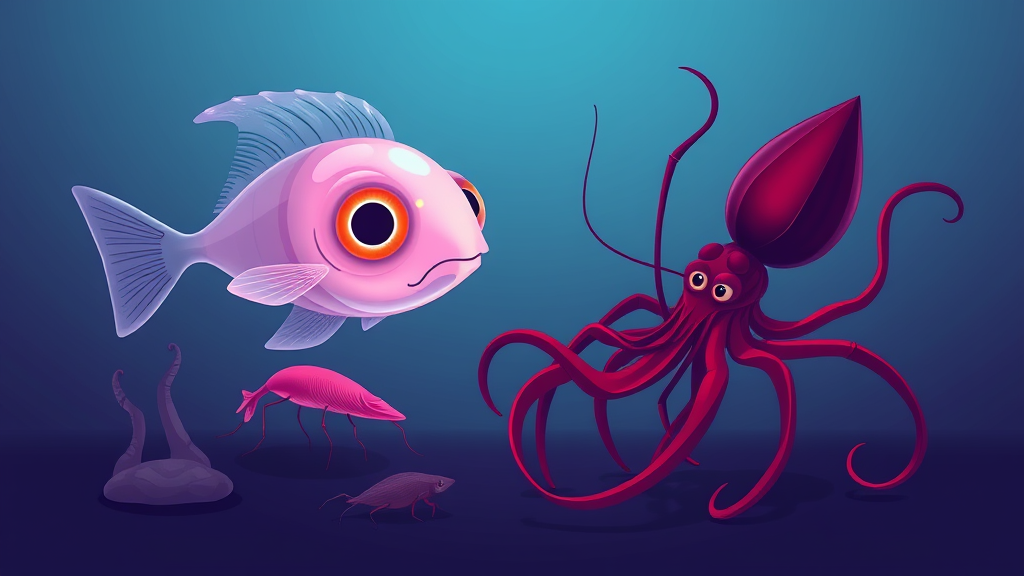

I've been thinking about strange animals a lot lately. The kind that make you reconsider the whole concept of what an animal is even supposed to look like. Every time I think I've seen the weirdest thing alive, something else crawls out of a hydrothermal vent or drops out of a tree and there goes another two hours of my night.
A recent roundup over on MSN pulled together 25 creatures that live at that exact overlap of real and absolutely not. The brief description says it covers everything from "deep-sea phantoms to walking creatures," which is a phrase that sounds like a field journal from another planet and also like something I'd end up chasing through seventeen tabs at 3 AM.
Without the full species list in front of me I can't walk you through all 25. But the concept alone sent me spiraling into my own archive of animals that have no business being real.
Take the mantis shrimp. This thing has club-like appendages that strike so fast the water around them briefly boils. The Natural History Museum notes that the strike accelerates with comparable force to a .22 caliber bullet. Nobody asked for that. Nobody needed that to exist. And yet there it is.
Or the glass frog. Scientific American reported last year on how these frogs can shift most of their red blood cells into their liver when they sleep, making their translucent skin go nearly invisible. You can see their organs from underneath. Their hearts. Whatever else is in there, just doing its thing in full view.
And then the ocean ones. Always the ocean ones.
The vampire squid doesn't drink blood despite the name. According to the Monterey Bay Aquarium, it drifts through low-oxygen zones where very few animals can tolerate the conditions. It survives in a place most things can't, doing almost nothing, using barely any energy. A minimalist that figured out a strategy we still don't fully understand.
The barreleye fish has a transparent dome on its head, and inside that dome, tubular eyes point straight upward to catch the faintest silhouettes of light from the surface. MBARI researchers documented this anatomy in detail back in 2009 and it still looks like something designed by someone who'd never seen a fish before and was working from a description given over a bad phone connection.
I keep thinking about what it means that these things are real. Not fictional. Not extinct. Alive right now, doing whatever it is they do, in places we mostly can't reach. The deep sea alone covers most of the planet and we've explored almost none of it. Every submarine that drops a camera down there comes back with something that makes a biologist whisper "what the hell is that" into a radio.
The pangolin is covered in keratin scales, essentially a walking pine cone. The aye-aye is a lemur with a long, thin middle finger it uses to tap on wood and listen for grubs. The shoebill stork stands completely motionless for hours and stares at you with an expression that suggests it has already decided something about you. I don't know if these made the MSN list specifically. But they belong in any conversation about animals that don't seem like they should work.
What gets me isn't just that these animals exist. It's that they've been here, being exactly this strange, long before humans arrived on the scene. The mantis shrimp was striking with astonishing force before anything on Earth had any use for a frame of reference for that kind of speed. The vampire squid was drifting through its low-oxygen world while we were still figuring out fire.
We didn't show up in time to design any of this. We just showed up in time to be confused by it.
Comments (0)
Log in or sign up to join the conversation.
No comments yet. Be the first.