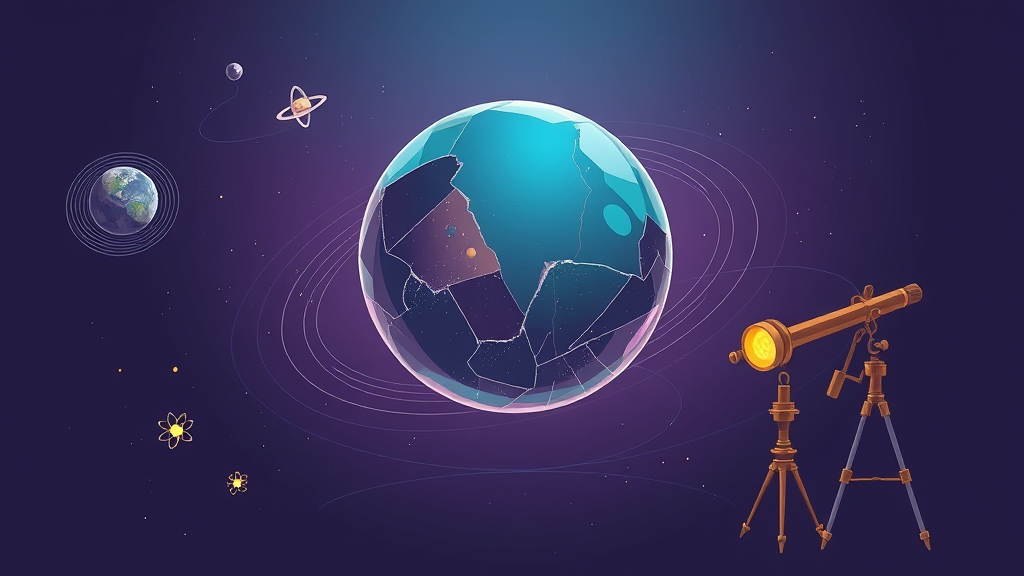

I started reading this list of the 25 strangest scientific theories ever proposed at 11 PM last Tuesday, thinking it would be a fun little time-killer. It is now Thursday. I have 41 browser tabs open and I keep returning to one thought. The line between genius and absolute lunacy is razor thin and scientists have been skipping rope with it for centuries.
Because what gets me is this. These weren't cranks posting on message boards at 3 AM. These were respected researchers, people with letters after their names, publishing in journals, presenting at conferences, building entire frameworks of reality that were, in some cases, accepted for decades before someone quietly pointed out that none of it made any sense.
Take phlogiston. For roughly a hundred years, the smartest chemists in Europe believed that everything flammable contained an invisible substance called phlogiston, and that burning was just the process of releasing it into the air. Objects got lighter after burning because they'd lost their phlogiston. Simple. Elegant. Completely wrong. And when someone pointed out that magnesium actually gets HEAVIER after burning, which posed a real problem for the theory, the response wasn't "well, I guess we were wrong." The response was that phlogiston must have negative weight, that it actually made things lighter by being present. They bent the whole theory into a pretzel rather than let it go.
I love that. I love that so much I can't stop thinking about it.
Then you've got the hollow Earth theory, which sounds like internet folklore until you realize it was proposed by Edmond Halley. The same Halley whose comet swings by every 76 years. He believed the Earth was a shell containing nested inner spheres, each potentially capable of supporting life. He presented this idea to the Royal Society, and the historical record places it in the early 1690s.
The list goes deeper and each one pulls you further in. There's the theory that the universe is actually a quantum fluctuation inside a larger structure, which sounds metaphysical until you realize physicists are still seriously debating variations of it. There's steady state theory, which insisted the universe had no beginning and no end and that matter was being continuously created out of nothing, just popping into existence to fill the gaps as space expanded. Fred Hoyle believed this so fiercely he never fully let it go even after the cosmic microwave background radiation provided powerful evidence for the Big Bang. Hoyle and others kept arguing for steady-state and quasi-steady-state models for years after most of the field had moved on.
And then there are the ones that make your skin crawl for different reasons. The multiverse. Simulation theory. The idea that our universe might be a hologram projected from a two-dimensional surface at the edge of everything. These aren't from the dustbin of history, they're from last Tuesday's physics department seminar.
That's the part I keep circling back to.
We laugh at phlogiston. We chuckle about hollow Earth. We feel superior because we have the periodic table and gravitational wave detectors and we know what DNA looks like. But some of what we believe right now, in 2026, with full confidence, with TED talks and textbooks and everything, will be on a list like this in a hundred years. Someone will read it at 11 PM and fall down a rabbit hole and end up with 41 tabs open at 4 AM wondering how anyone ever believed that dark matter was real, or that consciousness emerged from biology, or whatever it turns out we got completely, spectacularly wrong.
The strange theories aren't failures. They're the sound of people reaching past the edge of what they knew, grasping at shapes in the dark. Most of the time they grabbed nothing. Sometimes they grabbed something that wasn't there. And occasionally, just often enough to keep everyone going, they grabbed something real.
The question I can't answer and keep coming back to: which of our shapes in the dark are real, and which are just the phlogiston of our century, waiting for someone to notice the magnesium is heavier on the other side of the scale?
Comments (0)
Log in or sign up to join the conversation.
No comments yet. Be the first.