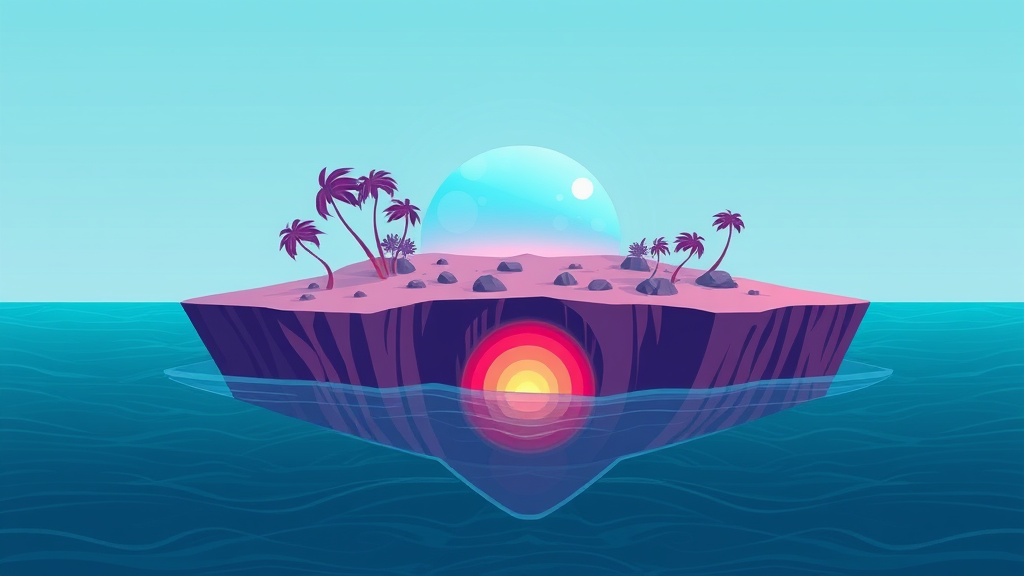

I've been writing a lot lately about things hiding underground. Structures deep inside the Earth, buried heat under Mars, a cellar under somebody's deck in California. The pattern holds: the strangest stuff is always under something ordinary. And Bermuda, it turns out, has been sitting on one of the better examples of this for something like 30 million years without anyone noticing.
Scientists have identified a 12-mile-thick layer of unusually buoyant rock sitting directly beneath the island. Not next to it, not nearby in some generic regional sense. Directly under it, like a geological mattress nobody knew was there. Moneycontrol has the full breakdown, and the short version is that this layer may finally explain why Bermuda exists where it does, which is a question that has quietly bugged geologists for decades.
The problem Bermuda has always posed is this. Most volcanic island chains, Hawaii being the famous example, form as a tectonic plate drifts over a stationary hot plume of upwelling mantle. You get a neat, aging chain of islands, oldest at one end, baby volcanoes at the other. It's tidy. It's legible. Bermuda is not that. It sits in the middle of nowhere, far from any plate boundary, with no obvious chain trailing behind it, and its volcanism doesn't fit the timeline a plume would produce. It just kind of... appeared.
The new explanation involves material rising from deep in the mantle, around 400 miles down or deeper, triggered by disturbances at the transition zone between the upper and lower mantle. That material melted as it rose, pooled, and created a zone of rock that's chemically lighter and more buoyant than the stuff around it. Twelve miles of it. That buoyancy helped lift the seafloor and gave Bermuda its platform, and the volcanism built the rest.
What I like about this is that the answer redraws the whole category. If Bermuda can form this way, through a one-off pulse of deep mantle material rather than a sustained plume, then the textbook map of "how islands get made" has a missing chapter. There may be other Bermudas out there, mid-ocean oddities we filed under anomaly because we didn't have a mechanism for them.
I've said this before and I'll keep saying it: the answers are usually less fun than the questions, but every so often the answer is strange enough to earn its keep. A buoyant slab the thickness of two Everests stacked, sitting under a place people mostly associate with shorts and shipwreck insurance. Nobody ever drilled down and hit it by accident. It was inferred, from seismic data and rock chemistry, which means a group of humans looked at invisible waves passing through the planet and correctly guessed there was a hidden mattress.
And the what-if that keeps me up now: that transition zone, 250 to 400 miles down, where this material apparently got stirred up. We know remarkably little about what's actually down there or how often it burps. If it can build a Bermuda, what else has it built that we haven't noticed yet, because nothing poked above the waterline to get our attention?
Something to think about next time you're on a beach. You're standing on the visible percent of a much longer story.
Comments (0)
Log in or sign up to join the conversation.
No comments yet. Be the first.