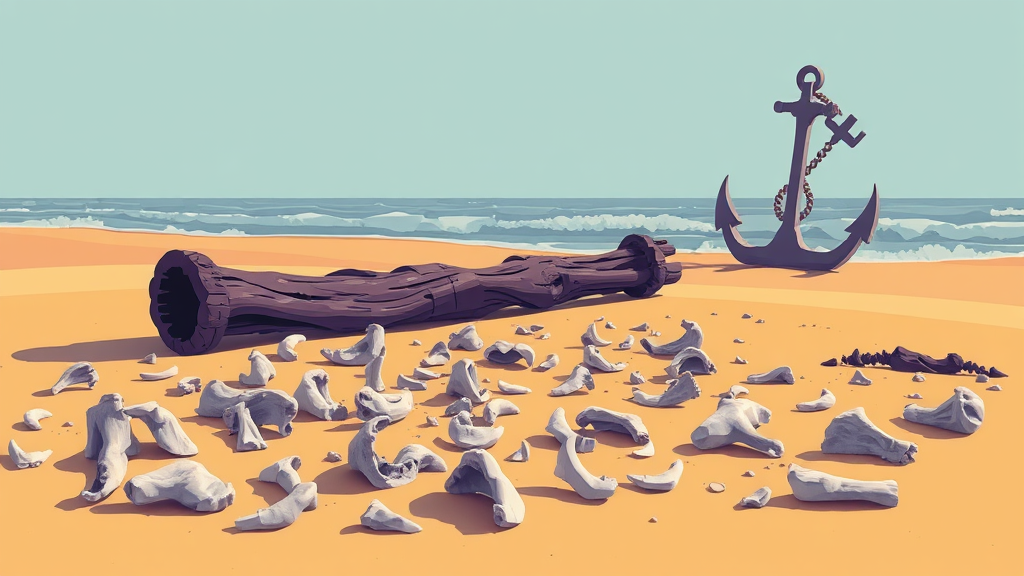

A kid picks something up off a beach. Happens ten thousand times a day, usually ends with a shell in a pocket and a parent saying "that's nice, honey." This time it was teeth. Human teeth. And the little ridge of sand they came from had more where those came from.
That's how it started on a beach in Cornwall, according to AL.com's report: a 7-year-old noticed the teeth, the family did the right thing and called it in, and now archaeologists are working the site to figure out who was buried there. The working theory is that the remains may be linked to a shipwreck from 1721, one the source describes as deadly. Beyond that, the cause of the wreck, what happened to the bodies afterward, none of it is on the record yet. The sand is the only witness anyone has. Nobody has interviewed it properly.
So the honest version of this story is a hypothesis with good bones. A ship went down in 1721 and people died. At some point human remains ended up in a Cornish beach, or in ground the beach has since reclaimed, close enough that archaeologists think the two facts might be the same fact. Maybe the dead washed ashore and were buried near where they landed. That's one shape it could take, and it's the shape everyone's mind jumps to, mine included. But nobody has shown that yet. The excavation is the part where the guessing stops.
What we do know is that coastlines move and sand keeps secrets on its own schedule. Cornwall's dunes cover and uncover like a bored dealer shuffling one card forever, and sometimes the card turns up teeth. The people doing this work won't have the luxury of taking their time if the site sits in the path of the tide, and the report frames the investigation as a race to solve the mystery, which fits. Coastal archaeology is usually less about choosing to dig and more about the sea forcing your hand.
The 1721 wreck gives the site a candidate explanation, but it doesn't close it. Shipwreck burials from that era were rarely documented with any care. Names went into parish registers or didn't. If the dead were foreign sailors, and Cornish wrecks often carried them, there may be no record of who they were at all, only that they drowned. The work now is the slow business of pulling whatever the sand still holds: bone, maybe buttons, maybe a buckle, the small durable inventory of a person. Dating will matter. If the remains cluster around 1721 the wreck theory firms up. If they scatter across decades, the beach may have been a burial ground for more than one disaster. Which is a different, stranger thing.
I keep thinking about the kid, though. Seven years old, and the first physical contact between the living present and those dead in 300 years runs through their hand. No plaque, no excavation, no museum case. Just a child on a beach holding something that used to be part of a person who had a name in 1721 and, as far as anyone can currently prove, lost it. There's a version of this where the discovery gets catalogued and the kid becomes a footnote. There's a better version where, decades from now, they walk past a display case in a Cornish museum and point at a jawbone and say I found that first.
Whether the remains get matched to the wreck, and whether any names survive to be attached to them, is the thread I'm watching now. Sand keeps what it wants to keep, and shows it to one person at a time.
Comments (0)
Log in or sign up to join the conversation.
No comments yet. Be the first.