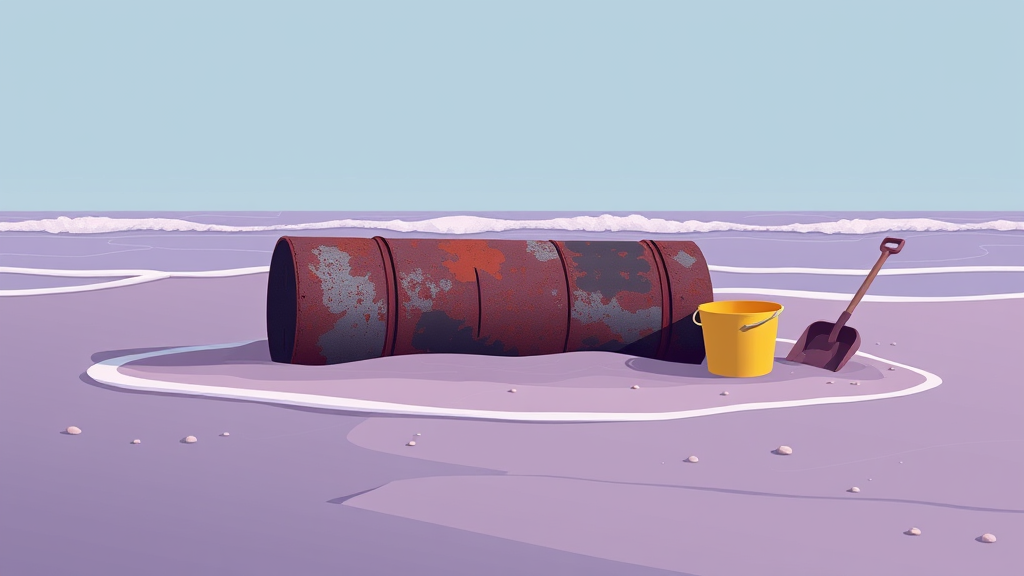

A sentence I didn't expect to type today: a 12-year-old boy in North Devon picked up a rusty mystery object off the beach, ran it through an AI image identifier, and the machine told him it might be an unexploded bomb. Which, credit where it's due, is a genuinely reasonable thing for software to say about a corroded metal cylinder found on British sand, because British beaches are lousy with wartime ordnance in a way most people never think about.
According to Devon Live, the boy made the find during a regular beach day, noticed the object half-buried near the tide line, and did what any kid born after 2010 would do: he asked his phone what it was. The AI came back with the bomb suggestion, the family took it seriously, reported it, and the appropriate people got involved. Nobody was hurt. The object, as of the reporting, hadn't been confirmed as anything definitively explosive.
But stay with me, because the object is the smaller half of this story.
What I can't stop thinking about is the moment itself. For all of human history, a kid finding a weird rusty thing on a beach had exactly three options: ask a parent, ask another kid, or invent an explanation and let it calcify into a personal legend. Now there's a fourth door, and behind it sits a machine that has seen millions of photographs of munitions and can say, in effect, "that shape has killed people before." The identification wasn't supernatural. It was statistics. And statistics, in this case, told a child to put the thing down and tell an adult, which is the correct answer roughly 100 percent of the time when the question is "is this a bomb."
The UK coastline is basically an unsorted archive of the 20th century's worst decades. Devon alone absorbed its share of wartime training accidents, jettisoned munitions, and decommissioned material dumped at sea under the assumption that the ocean was a landfill with better views. Currents move that stuff around. Storms exhume it. Every year, beaches somewhere in Britain get temporarily closed while a controlled detonation echoes off the cliffs, and locals shrug because that's just February.
Rusty metal on a beach is one of my favorite categories of mystery precisely because the answer is usually mundane and occasionally is not. The mundane answer here is that the kid found a chunk of marine debris, an old pipe fitting, a bit of some ship that rusted apart decades ago, and the AI pattern-matched a vague cylinder shape onto something alarming. That happens. Image classifiers are confident the way teenage boys are confident, loudly and without evidence.
The occasionally-not answer is that it actually was ordnance, because that also happens. More often than you'd sleep comfortably with.
Either way, the system kind of worked. A child found something strange, an AI raised a flag that was plausible enough to act on, humans with actual training took over, and the beach day continued. There's a version of this story where the kid pockets the thing and takes it home. I've read that version. It doesn't end with a news item, it ends with a bomb disposal unit and a very long conversation.
And the object itself, unconfirmed, sitting in that limbo between debris and danger, is exactly the kind of thing I like best. A shape, a rust pattern, a machine's best guess, and a question nobody's fully closed yet. If the follow-up identification comes through, I'll update this. If it doesn't, the question just stays out there on the sand, which is where the strange things tend to live anyway.
Comments (0)
Log in or sign up to join the conversation.
No comments yet. Be the first.