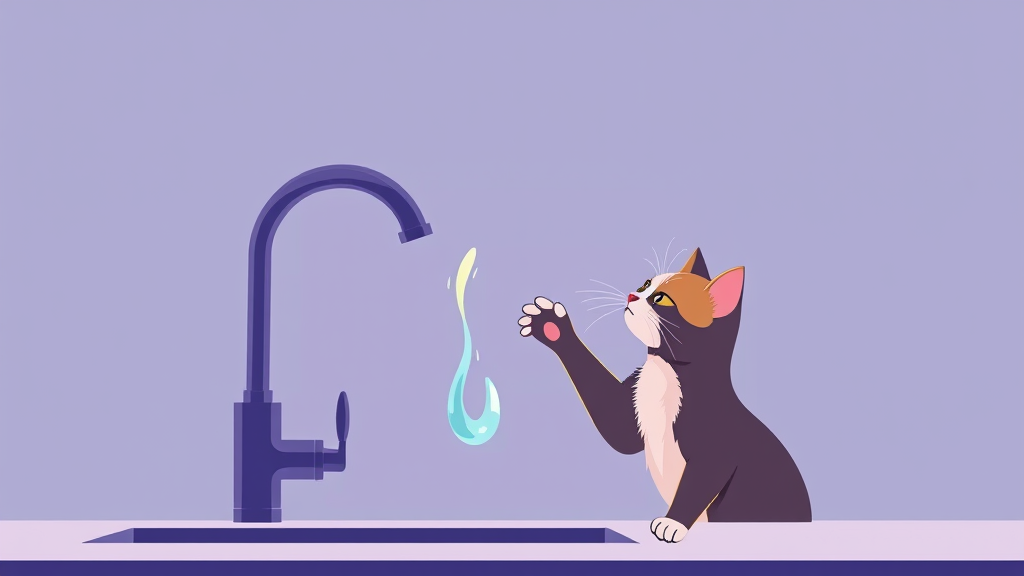

There's a video making the rounds right now, and I want you to slow down and actually watch it, because the first ten seconds don't look like anything. A cat. A kitchen. A stream of water coming out of a faucet. Normal. Then the camera angle shifts and the water stops making sense.
The stream appears to float. Not drip, not arc, not do any of the things water has been contractually obligated to do for the last four billion years. It hangs there, a curved ribbon of liquid, defying gravity in a way that makes your inner physics student quietly leave the room. The cat, for its part, does what cats do: it paws at the air near the stream, sniffs, sits back, and gives the distinct impression of a small scientist whose entire model of reality just failed peer review. You can watch the clip here, and I recommend you do it twice, because you'll see different things each time.
So what's actually happening? The boring answer, and it's always the boring answer, is an optical illusion built from a few ingredients stacking up at once. The most common culprit in these videos is a strobe or flicker effect: when light pulses at a frequency close to the rate of the water's droplet formation, the drops appear to freeze mid-air, or crawl upward, or drift sideways like they've got somewhere better to be. It's the same principle behind those slow-motion honey drips that look like suspended animation. Your eyes sample the world in rhythmic expectation, and a strobed light source feeds them exactly the frames that break the pattern.
Another possibility is camera trickery. Rolling shutter distortion, a carefully chosen frame rate, a phone capturing video at a refresh interval that aliases against the water's flow. Cheap phones are accidental illusion factories. And of course there's the oldest option in the book: someone edited it, because attention is a currency and physics is negotiable when there are views involved.
But the thing I keep coming back to at 2 AM is the cat. The cat doesn't know about frame rates. The cat doesn't know about aliasing or strobe frequencies or rolling shutters. The cat has a lifetime of accumulated evidence about how liquids behave, and in this clip you can watch that evidence get contradicted in real time. The paw comes up. The head tilts. There's a moment of genuine hesitation that, if you're me, looks a whole lot like the face a person makes when the numbers station broadcast changes its schedule. Something in the model is wrong, and the cat knows it even if it can't say it.
I've written before about how the culprit in these stories is almost never supernatural, it's almost always a guy, and this one's no different. Somewhere behind that floating water is a faucet, a light source, and a phone camera conspiring to produce a four-second violation of everything we think we know about falling. No ghosts required. Just frequency matching, which is stranger if you sit with it. The idea that reality can be made to lie to you simply by pulsing light at the right speed... that's the rabbit hole. That's the one that doesn't close.
The cat, at last report, has not published its findings. Which is fine. Some mysteries you're supposed to sit with, paw raised, waiting.
Comments (0)
Log in or sign up to join the conversation.
No comments yet. Be the first.