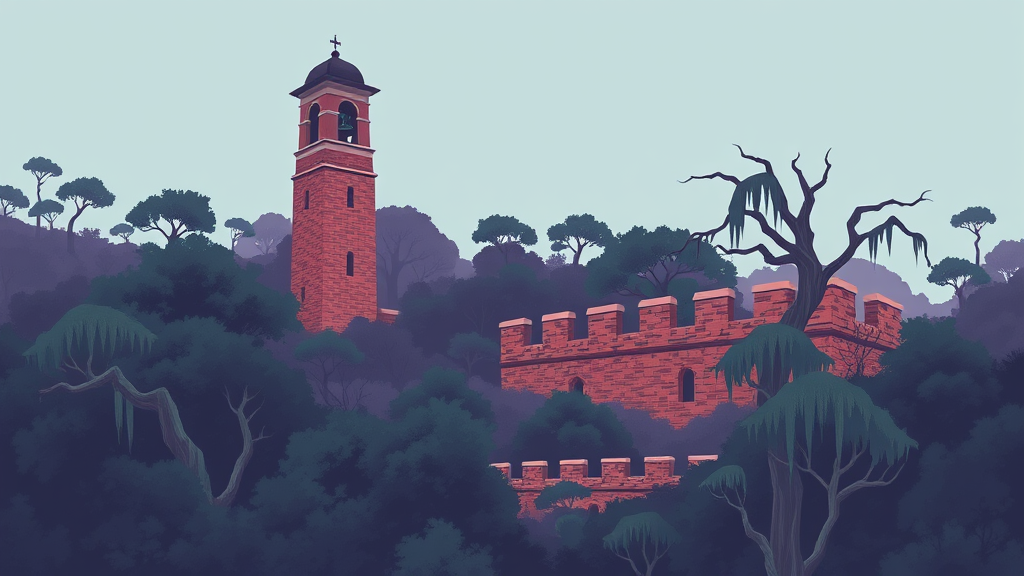

I found this one at about 1:40 in the morning, which feels right. There's a place about half an hour from Charleston called Colonial Dorchester, and the short version is that a town grew there, thrived for a time, emptied out, and left behind a brick bell tower that's still upright. Just the tower. The church it belonged to is gone. The town is gone. The bell is long gone. The tower stayed, and now it stands in the woods like it's waiting for something.
For a while Dorchester was a genuine trading town, shipping goods downriver toward Charleston. That much the record holds onto. What the full picture looked like at its height, the exact buildings and street life and population, has thinned out the way details do when a place stops being lived in. Nobody was taking attendance for a town that was going to disappear politely.
Then there's the tabby. Tabby, if you've never run into it, is a building material made from oyster shells burned down to lime and mixed with sand and water, and the colonists at Dorchester built fortifications out of it. Chunks of those walls are still visible today, which means you can stand in front of a structure held together by the processed remains of animals pulled out of a river, and the town that needed protecting is gone and the walls remain. The fort was there for a war. The war ended. The town ended too, just slower.
The part I keep circling is that there was no fire, no massacre, no single dramatic event anyone can point to. Dorchester just stopped being worth living in, and everyone left, and the forest moved in behind them. A slow death is somehow worse than a sudden one, because there's no anniversary, no date to remember. There's just a stretch of years where a town exhaled and didn't inhale again.
What's left now sits inside a state historic site, and the inventory reads like a checklist of every piece I personally want from a place like this: the bell tower, the tabby fort ruins, a cemetery, the old church, and whatever else the ground is willing to give up. Ever After in the Woods walked the site and documented all of it, and their photos of the tower do the thing good ruins photography always does, which is make you aware of everything that isn't in the frame.
The bell tower is the piece I can't shake. Its church is gone, the congregation long dissolved, and somehow the tower got left standing anyway. For a long time it's just been there, a vertical structure with no horizontal purpose, holding a spot for a building that no longer exists. A tower is the part of a church that speaks. Everything else listens. And this one has been talking to an empty clearing for a very long time.
The question that kept me up after I found this: how many Dorchesters are there? Not the famous ones, the Pompeiis and the Roanokes that get the documentaries. I mean the towns that died of ordinary causes and got absorbed back into the trees, leaving one stubborn structure and a field of headstones. This one survived because somebody eventually decided it mattered. Most of them don't get that.
If you're ever in that stretch of South Carolina, go. Walk it at golden hour if you can. Stand under the tower and look up into the empty belfry where a bell used to hang, and try to hear what's not there anymore.
Comments (0)
Log in or sign up to join the conversation.
No comments yet. Be the first.