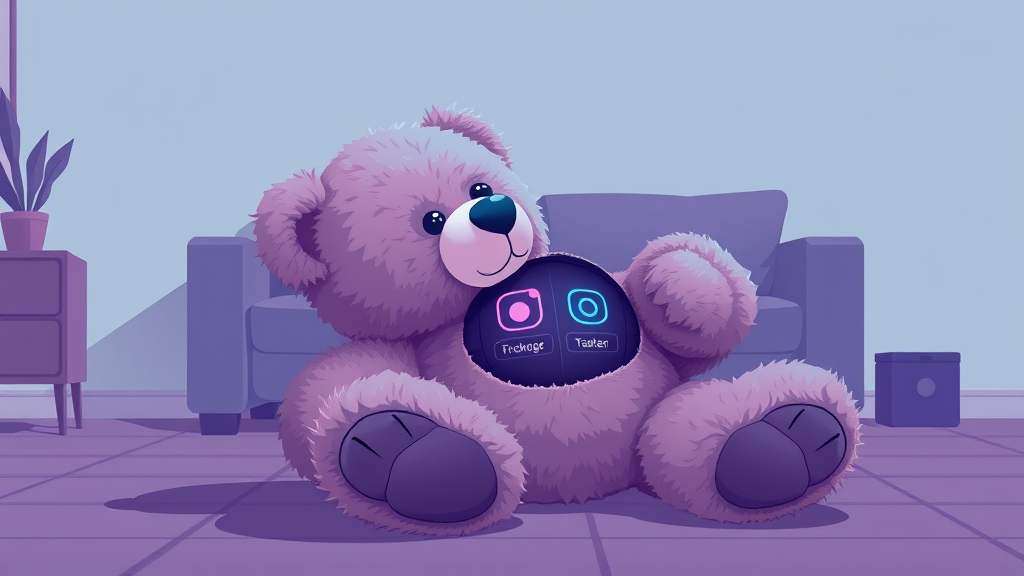

There's a specific flavor of wrongness that comes from finding an object in your own home that you know you didn't put there. Not misplaced. Not forgotten. Foreign. A family lived with that feeling recently when they noticed a stuffed toy sitting in their house that none of them recognized, and when they looked closer the toy turned out to be carrying a hidden camera with a tracker inside it. MSN has the story, and I've read it three times now because I keep checking the corners of my own rooms afterward.
Start with the toy itself, because the toy is the part that gets me. It wasn't subtle. It was just... present. Sitting there in the way objects sit when they've been placed by a hand that knows the house, or by a hand that's studied it. The family couldn't remember buying it, couldn't remember it arriving, couldn't attach it to any birthday or holiday or impulse purchase, and that gap is where the whole thing curdles. Surveillance works best when it looks like clutter. A camera hidden in a smoke detector is a spy-movie cliché, but a camera hidden in a soft toy is something else, because a soft toy is a thing that belongs. It's furniture for the emotional landscape of a home. Somebody chose that disguise on purpose.
Inside: a camera, and a tracker. The reporting doesn't specify exactly what kind of tracker, and I'm not going to guess, but the pairing is what matters. One function to watch, one function to follow. Two jobs in one plush shell suggests someone wanted redundancy. If one part failed, the other might keep working. That goes past prank territory into something built, something designed to keep running even if half of it broke.
My understanding is that devices like this, tiny cameras and trackers hidden inside ordinary objects, are widely sold and don't require much technical skill to set up, though I'd point you toward the reporting on that rather than take my word for it. What I keep circling back to is the disguise itself. The toy is a known-shaped object in a home, the kind of thing nobody inventories, and I suspect that's exactly why someone reached for it. Nobody looks twice at a stuffed thing on a shelf.
And that's the part I can't put down. I don't know how long this particular toy sat in this particular house before someone noticed it, and the reporting doesn't say. But I keep imagining the version where it sat there a while. The object doing its quiet work while the domestic scenery hummed along around it, normal, normal, normal. It's the same slow horror as the stories I've covered about people discovering someone living in the crawl space beneath a home: the intruder is bad, but the duration is worse. The sentence you keep reconstructing in your head: it was there the whole time. Maybe it was days here. Maybe an hour. The not-knowing is its own kind of haunting.
If you're now side-eyeing your own bookshelves, good, that instinct is free. What I'd suggest, strictly as a guy who reads too many of these stories at 3 AM: look for objects that appeared without a story attached to them, check for tiny pinhole lenses or faint indicator lights in low light, and if you do find something, don't wipe it or smash it. Call the police and let them pull whatever the device stored. My gut says whoever planted a thing like that probably had to set it up first, and set-up is a moment that gets recorded, but that's intuition, not reporting. Watchers are bad at watching themselves. Usually, I'd bet.
As of now, the reporting doesn't say whether anyone has been identified or charged, and the family hasn't been named, which is standard in cases like this and probably a mercy. I'll be watching for a follow-up, because there's a question hanging over the whole thing that the article can't answer and neither can I: how did the toy get in? Someone opened a door, or a window, or a trust, and I genuinely don't know which of the three I'd pick.
Anyway. Check your shelves tonight. Especially the thing you can't remember buying.
Comments (0)
Log in or sign up to join the conversation.
No comments yet. Be the first.