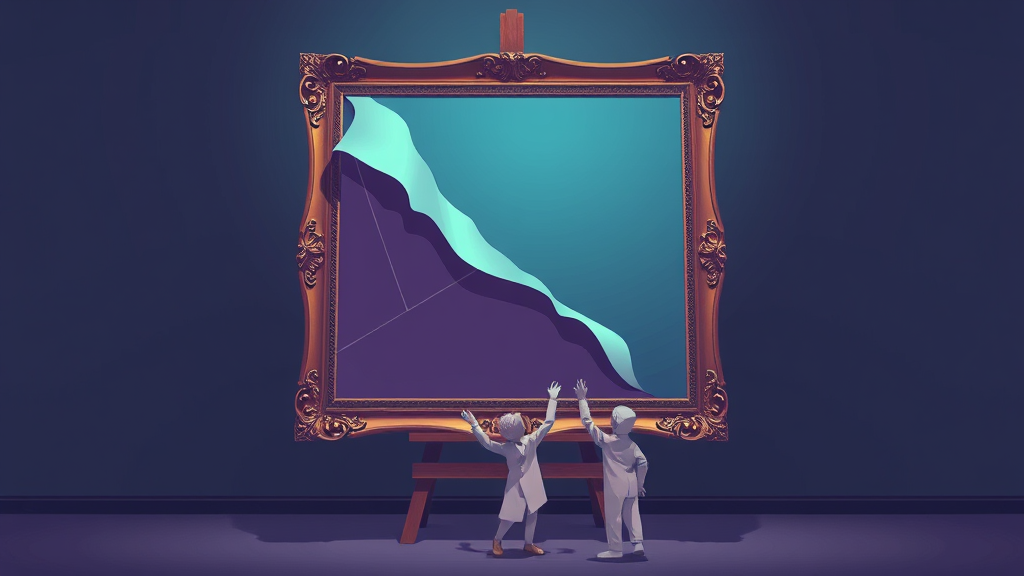

I found this one at the hour when I should've been asleep, which is how the good ones always arrive. Ismael O. Cardona wrote The Painting originally in honor of his daughter, a sweet origin for a book, and then somewhere along the way the thing grew an unexplained painting at its center, shifting realities, dangers nobody sees coming, and friendship as the load-bearing wall holding the whole structure up. You can read the full piece over at Financial Content, but stay with me for a second, because the premise is doing something I keep turning over.
A painting you can't explain. Not a haunted painting, at least not on the surface, not yet. Just a painting that shouldn't do what it does. The promotional material is careful about how much it gives away, which I respect, because the worst thing you can do to a mystery is summarize it. What we know is this: characters step into a story where reality shifts under them, where the picture and the world start trading places, and where the twists are built to keep you from setting the book down at a reasonable hour.
And the friendship part matters here more than it might sound. Supernatural adventure stories tend to treat companions as expendable, bodies for the plot to spend. Cardona's framing puts true friendship at the center of the supernatural machinery, which suggests the book understands something a lot of darker fiction doesn't: the strange is scarier when someone's standing next to you, and braver too. Every good piece of weird fiction runs on this, from A Wrinkle in Time onward. The unexplained is cold. Company is warm. Put them in the same room and you've got a story.
The origin keeps pulling at me, though. A father writes a book for his daughter, and the book he writes is about a painting that bends reality. There's a version of this where that's just a sweet dedication page and nothing more. But I keep thinking about how the gifts parents make for their children almost always carry something the parent didn't plan to put in there. You set out to write an adventure and you end up writing about what you'd do to protect someone, or what you're afraid of losing, or both. I don't know Cardona and I won't pretend to know which of those ended up on the page. But the shape of it rhymes with the book itself, a made object that becomes stranger and more alive than its maker intended.
Which is, if you've read me before, kind of my whole territory. I wrote about the Lycurgus cup a while back, a 1,600-year-old Roman goblet that changes color depending on how the light hits it, and what stuck with me wasn't the nanotechnology. It was that somebody made a thing that behaved like it was alive, and we're still not entirely sure how. Paintings and goblets and books are all the same category of object at 3 AM: containers that hold more than their makers poured into them.
The genre-blending here is deliberate. Mystery structure, supernatural stakes, adventure pacing, an emotional core about the people you'd walk into a shifted reality with. That's a lot of dials to turn at once, and books like this live or die on whether the writer keeps them in balance or lets the twists eat the friendship, or the friendship sand off the mystery's edges. The early framing suggests Cardona knows the balance is the point.
I'm going to read it. Consider that my review, such as it is. A book born as a gift to a daughter, about a picture that won't stay put, written by someone who apparently believes the strangest doors are worth walking through as long as you don't walk through them alone.
If you pick it up and the painting does something I haven't described here, find me. You know I'll be up.
Comments (0)
Log in or sign up to join the conversation.
No comments yet. Be the first.