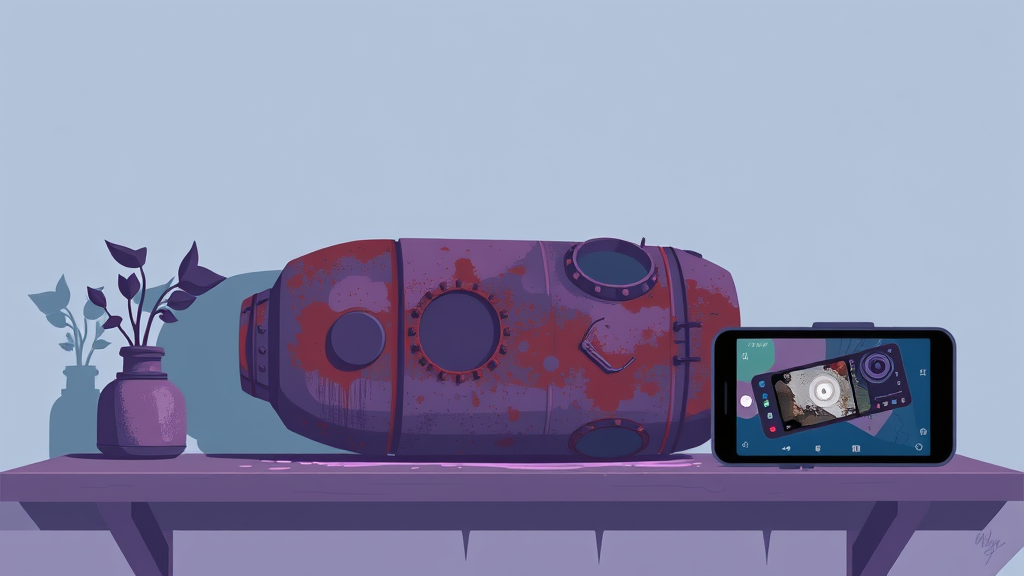

Sit with this scenario for a second. There's an object in your home. It's been there for ten years. You walk past it every day, maybe dust around it. And the whole time it has been a live question, except nobody in the house knew the question was being asked.
A grandfather in Kemsley, near Sittingbourne in Kent, pointed his phone at a lump of corroded metal that had sat on his shelf for a decade, and Google Lens told him it matched Second World War ordnance. Not a decorative relic. Not a bit of old farm machinery. A bomb. Kent Online reports that the AI identification is what surfaced the truth about the object, which had quietly accrued ten years of shelf normalcy while being something else entirely.
It's the identification itself I keep circling back to. The interesting moment in this story isn't any aftermath, which the reporting doesn't walk us through. It's the instant the app delivered its verdict, when the family had to decide whether to believe a piece of software about an object that had lived in their home since roughly 2016. Google Lens doesn't know things the way an ordnance officer knows things. It pattern-matches against millions of images and produces a statistically flavored guess. And in this case the guess, going by the family's own account to Kent Online, was terrifying.
I wrote last month about a boy on a Devon beach whose phone AI suggested his rusty find might be a bomb, and now here's the same shape of story again, inland this time, on a domestic shelf. Unexploded ordnance might be the perfect ghost story for the machine age. It's old violence that never finished happening. It sits in the soil, or the shed, or on the mantelpiece, patient beyond human patience, and the only thing that changed in Kemsley is that somebody finally asked.
The part I can't stop thinking about is how little actually changed. The object didn't change. The shelf didn't change. What changed is that for the first time in ten years, someone had a tool in their pocket that could look at the familiar and report back that it was never familiar at all. Every unexploded bomb story is secretly a story about attention. The thing stayed invisible, and dangerous, right up until someone pointed a lens at it and the invisibility failed.
For general context, none of which comes from the Kent Online report: the UK turns up wartime ordnance often enough that disposal is practically a municipal genre, and Kent, sitting where it sits, plausibly got more than its share of both the bombing and the industry that made the bombs possible. Old soldiers brought things home. Kids dug things up. Objects migrated indoors and became furniture. I'd guess museums have seen enough shelf donations over the years to have opinions about this, but that's my speculation, not sourced reporting.
So check the shelf. Especially the piece nobody can quite explain, the one that's been there so long it's stopped being an object and become part of the room. If you point your camera at it and the app hesitates even slightly, don't argue with the phone. Call someone whose job it is to know.
The lesson isn't that AI is magic. It's that we live surrounded by unasked questions, and every so often a tool comes along that asks them for us, whether we wanted the answer or not.
Comments (0)
Log in or sign up to join the conversation.
No comments yet. Be the first.