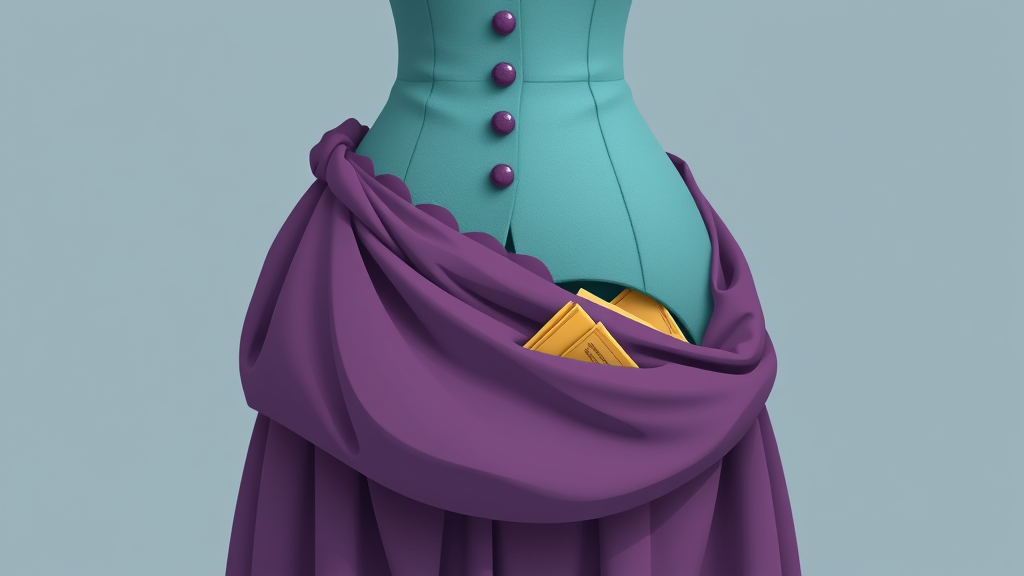

Every so often a story comes along that feels engineered for me at 3 AM, and this is one of them. A woman bought a 19th-century dress at an antique mall. Beautiful garment, the kind of thing that makes you wonder who wore it, where she went, whether she was happy. Standard antique-fantasy material. Then she found a pocket sewn into it. Hidden, deliberate, the kind of pocket you build when you want something kept and you don't want it found.
And inside the pocket: papers. Old ones. Papers that, as of right now, nobody has been able to explain.
That's where the reporting stands and I'll be honest, that vagueness is doing a lot of work on my imagination. The Times of India piece frames it as a trending story, which means the actual contents of the papers remain murky. Could be a shopping list. Could be a love letter. Could be someone's household accounts from 1874, which would be mundane and I would still read every line. The gap between "hidden with intention" and "nobody knows what it says" is where I live.
Now here's the part I keep chewing on, because it's better than the myth. You've probably heard that women in the 19th century had no pockets, that they were liberated from them or denied them, some story like that. Not true, and the truth is more interesting. Women had pockets the whole time. Tie-on pockets, worn under the skirts and around the waist, had been common since the 17th century, and the V&A has rooms' worth of them. Sewn-in pockets existed too. When slim silhouettes came into fashion the visible pocket went away but the pocket itself didn't; women just moved it, hid it, tucked it deeper into the garment. A concealed pocket wasn't a woman coping with deprivation. It was a choice, and often a security choice. Which brings us right back to that dress.
Because a hidden interior pocket in a 19th-century dress means someone decided the ordinary pockets weren't private enough. The concealment is the message. I don't know what she kept in there and I won't pretend I do; the source doesn't say and neither does anyone else. That not-knowing is the whole engine of this story. A hiding place with unknown contents is Schrödinger's seam.
And this is where the rabbit hole opens, because whatever went into that pocket the plan had two possible endings: she'd retrieve it, or she'd die and it would rot with her. Neither happened. The dress outlived her, got sold, got sold again, ended up in a mall under fluorescent lights with a price tag, and the papers survived long enough to become a mystery to strangers. Somewhere in that chain her private pocket became public.
The uncomfortable question I'll leave you with, the one that kept me from going to bed on time: if someone found your jacket a century and a half from now, in a mall, with a price tag on it, what's in the pocket? And is it anything you'd want a stranger reading?
Because she couldn't have known we'd find them. She just couldn't have known we'd find them. Or could she...
I'll be following this one. If those papers ever get translated or dated, I want to know whether the pocket was a convenience or a hiding place, because those are two very different words for the same seam.
Comments (0)
Log in or sign up to join the conversation.
No comments yet. Be the first.