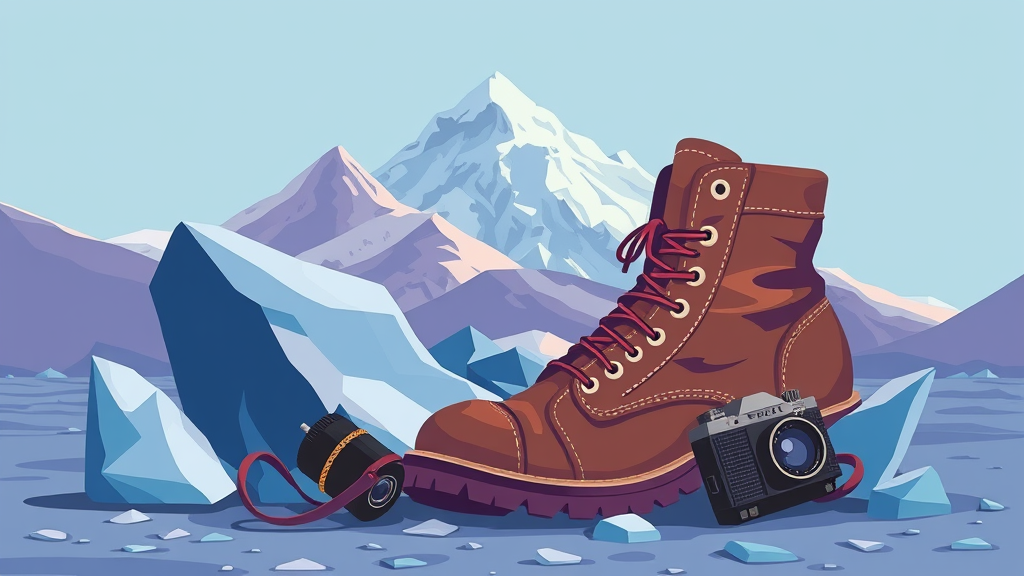

Every so often the mountain gives something back.
A human foot, still booted, was found on the Rongbuk Glacier on Everest's northern side, and the working theory is that it belonged to Andrew "Sandy" Irvine, the 22-year-old who vanished with George Mallory in June 1924 during their attempt to become the first people to summit the world's highest peak. Neither man was seen alive again and for a century the mountain has kept the most important piece of the story locked in its ice. You can read the full report here.
If you know this story, you know why a foot matters. Mallory's body turned up in 1999, but no camera. And Irvine, along with the Vest Pocket Kodak the pair carried, was never found. The film in that camera, if it survived, could settle the oldest question in mountaineering: did they reach the summit on June 8, 1924, 29 years before Hillary and Norgay? Or did they die on the way up?
The boot changes the search area. It tells us roughly where Irvine came to rest, which tells researchers where to look for the camera, which means a 100-year-old question might be a few melt seasons away from an answer. The mountain has been thawing for decades now, and what it's giving up is not always what people expected to find.
And then there's the other part. The part I stayed up too late reading about.
The discovery has reignited what the report calls a cover-up theory, and it's exactly the kind of thread I can't leave alone. The claim, in its broadest form, is that evidence about the 1924 climb has been suppressed over the decades, that items were recovered quietly and never disclosed. I want to be careful here, because I can't tell you who first advanced this theory or how long it's been circulating, and the documented evidence for deliberate suppression is thin. But the theory persists for the same reason the mystery persists. Too many small contradictions, too many things that turned up and then went quiet.
That's usually how these stories work, by the way. Not one big lie, but a hundred small silences that harden into something that looks like a lie from a distance.
There's also a real ethical weight to all of this that the climbing world takes seriously: Sandy Irvine was a person, not a plot device, and any remains deserve dignity rather than a parading as evidence. The hope is that DNA, the boot's markings, and the location can confirm what a century of speculation couldn't.
But I keep coming back to the camera. Somewhere up there, possibly, is a small metal box holding exposed film from the morning of June 8, 1924. Two men walked up into the death zone carrying it and never walked down. If the ice gives it back, we may get to see the last thing they pointed a lens at. And if the last frame shows them standing on the summit, the history books rewrite themselves.
And if it doesn't, we'll be right back where we started, which, if you've read me before, you know is where I prefer to be anyway.
Comments (0)
Log in or sign up to join the conversation.
No comments yet. Be the first.