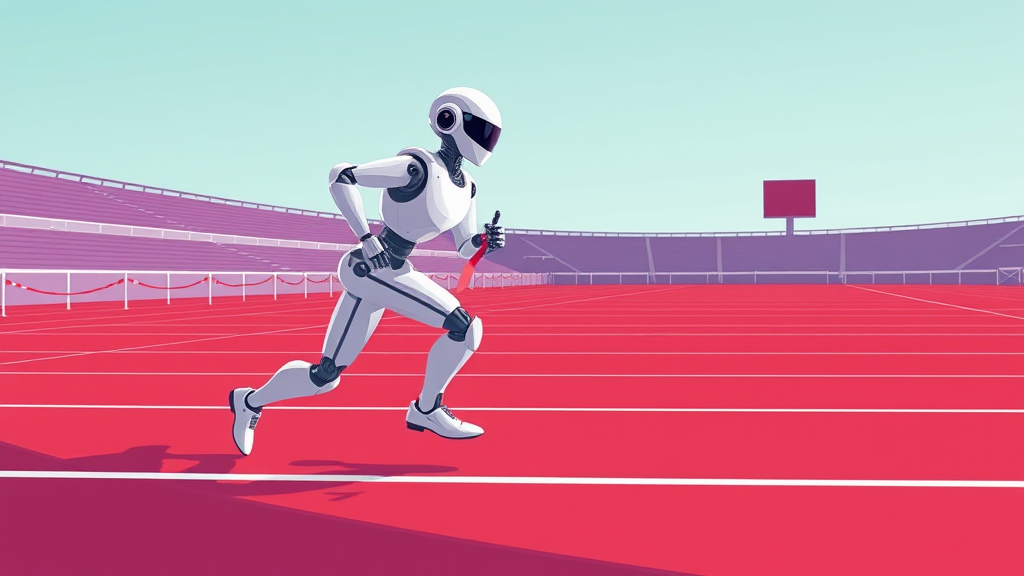

Usain Bolt's 100 meter world record has stood since 2009. Nine point five eight seconds, a time so far beyond what any human has run since that it started to feel less like a record and more like a boundary, something the species simply bumps up against. Last week, at the World Humanoid Robot Games in Beijing, a robot built by the Beijing Innovation Center of Humanoid Robotics covered the same distance in 9.39 seconds, and the boundary moved.
According to the coverage, the run happened at a competition designed entirely for humanoid machines, sprinting and all, which is its own strange new category of event. This wasn't a wheeled chassis on a rail. It was a bipedal robot, which means it had to solve the same problem Bolt solves: the awful physics of being a tall column of mass that has to fall forward, catch itself, fall forward again, a few dozen times in a row, without ever quite collapsing.
Walk is easy. Sprint is a controlled accident.
I keep circling back to that, because it's the part the headline number hides. For years the viral humanoid robot videos were cautiously staged, machines shuffling through warehouses at the speed of a tired mall walker. The joke was that the robots were coming for us and we'd have a full day's head start. That joke has quietly expired. Something with two legs and no lungs just ran faster than the fastest human being who has ever lived, and it did it without a single heartbeat, without lactic acid, without the part of the brain that screams at you to stop at 80 meters.
Bolt's run was a biological event, a one-off convergence of genetics and training and a tailwind in Berlin. The robot's run is a floor. I can't shake that difference. Human records decay slowly and get shaved by hundredths of a second; machine records compound, because every iteration gets better motors, better gait software, better balance algorithms. Somewhere right now there's an engineer looking at 9.39 and seeing the slowest their robot will ever be.
Now, the asterisks, because there are asterisks, and I'd rather give them to you straight than let the number do all the talking. I haven't seen the wind conditions, the surface, or the exact rules of the event confirmed in detail, and robotic sprint records have a history of very specific asterisks: tethered power, downhill track assists, editing. A 100 meter record run by a machine doesn't diminish Bolt's mark, either. It runs parallel to it. Nobody watched a forklift lift a car and declared human weightlifting dead.
But that's not really where my head is at 1 AM with this tab open. Where my head is: the World Humanoid Robot Games exist now. There's a venue, and a crowd, and a finish line, and a machine crossing it faster than anything with a pulse ever has. We built a species-shaped thing and put it in the starting blocks we built for ourselves. I wrote a couple weeks ago about Duplantis, an athlete whose only real competition is his own previous records, and how quietly strange that must feel. Turns out humans now have something on the other side of that equation too. The robots aren't chasing us yet. They're just, for the first time, running the same race.
Keep the lights on.
Comments (0)
Log in or sign up to join the conversation.
No comments yet. Be the first.