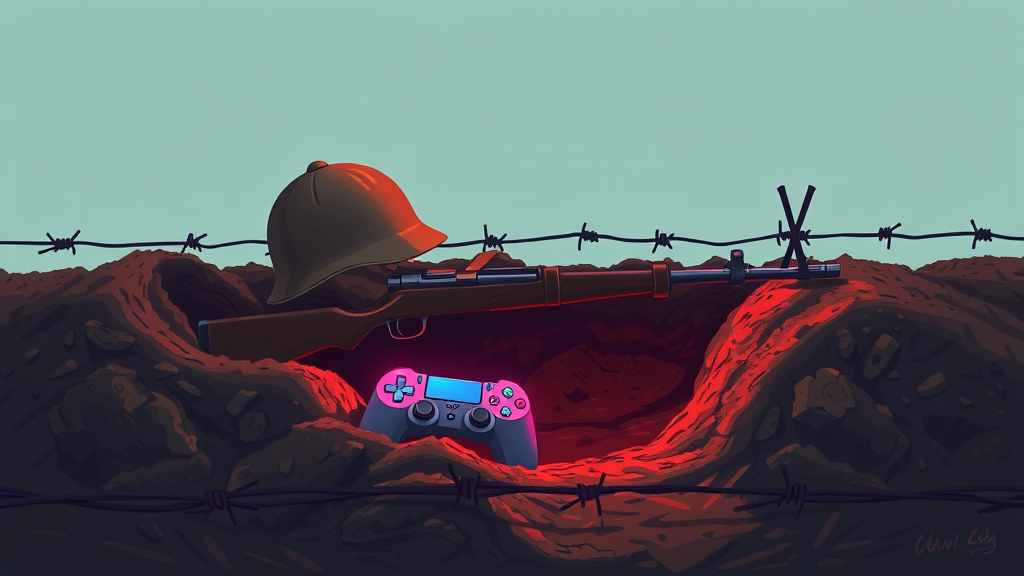

Every few years a game shows up that makes people who don't play games ask whether games should be allowed anywhere near certain subjects. This time it's Gallipoli, and the question, once again, is whether letting players interact with one of history's bloodiest military disasters trivializes it. The Conversation has a thoughtful piece on it, worth a read whether you land on yes or no.
My answer, after four decades of watching this exact argument play out, is that it depends entirely on execution. The medium isn't the problem. It never has been.
We've been here before. When Medal of Honor hit the PS1 in 1999, there were op-eds about whether WWII was too raw for a game. Then Brothers in Arms came along and was arguably more historically serious than most WWII films. Then This War of Mine in 2014 asked you to survive as a civilian, not a soldier, and nobody who finished it called it trivial. Spec Ops: The Line weaponized your own expectations against you. Papers, Please made bureaucratic cruelty feel heavy in a way a hundred documentaries hadn't managed for me.
A game can be crass about war. Plenty are. So are plenty of movies, novels and heavy metal albums. The difference is that interaction, done well, forces a kind of accountability passive media can't reach. When the game makes you do the thing and then asks how you feel about having done it, that's not trivialization, it's the whole reason the medium exists.
The risk with Gallipoli specifically is the framing. That campaign carries enormous weight in Australia, New Zealand and Turkey, ANZAC Day exists because of it, and if a game treats it as a multiplayer map with respawn points and a leaderboard, yeah, that's a problem. If it treats it the way 11-11: Memories Retold treated WWI, as a human story you move through rather than a kill counter you rack up, then it might do what the best historical games do: send players off to read the actual history.
I learned more about the Peloponnesian War from a Koei strategy game as a teenager than from any textbook, because the game made me care enough to look things up. I want to say it was a rental from the strip-mall place by my house, dictionary on my lap for the city names. This medium's critics consistently miss what it can do there. Nina and I have argued about narrative delivery for years, her MMO epics versus my single-player Final Fantasy, but we agree on this: the best stories in games are the ones that respect your presence in them.
The Conversation piece raises the question of how history gets framed, and that's the right question, much better than the blanket "should this exist." Who made the game matters. Whose perspective it centers matters. Whether the Turkish side is a set of enemy sprites or actual people matters. These are craft questions, the same ones a good historical novelist wrestles with.
What I'd suggest is holding judgment until you've seen how the thing actually plays. The tragedy isn't that someone made a game about Gallipoli. The tragedy would be a bad game about Gallipoli, and those are two very different failures. One deserves a debate. The other deserves a bad review.
And I've written enough bad reviews to know the difference.
Comments (0)
Log in or sign up to join the conversation.
No comments yet. Be the first.