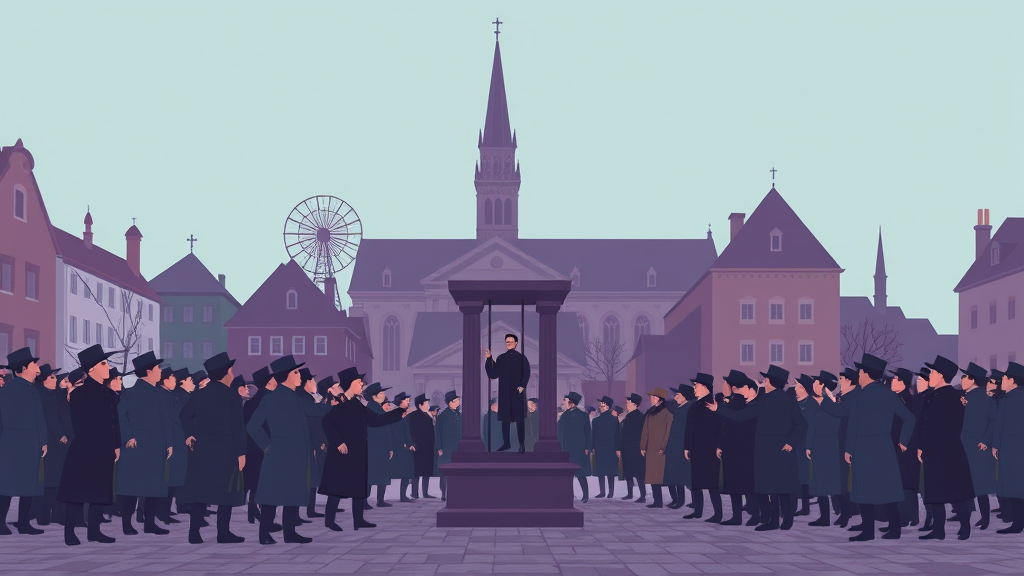

Christopher Clark has spent his career writing about how societies come apart, and now he's turned that lens on a single 19th-century scandal in Königsberg, the old Prussian city that no longer exists under that name. The book is reviewed in full over at The New Yorker, and I've been sitting with the review for a few days now, because the whole thing functions like a time capsule with the lid left slightly ajar. You keep catching the smell of the present wafting out of it.
The setup is pure rabbit hole material. A scandal erupts in a provincial capital, the kind of place where everyone knows everyone and therefore everyone knows, with total certainty, exactly what happened. The city splits. Pamphlets circulate. People who were in no room where anything occurred develop airtight opinions about what occurred in that room. And the actual truth, the thing underneath all of it, turns out to be far more slippery than anyone involved was comfortable admitting.
Clark's project, as The New Yorker's reviewer frames it, isn't really about guilt or innocence. It's about the machinery. How a community manufactures certainty. How public shaming in a pre-internet town worked at roughly the same speed and with roughly the same damage radius as it does now, just with more steps. The printing press was the platform. The pamphleteers were the replies and quote-tweets. Nothing about the underlying psychology needed upgrading in the intervening century and a half.
I keep coming back to that part. We tend to assume shame used to be a local phenomenon, contained, almost quaint. You disgraced yourself in Königsberg and your disgrace stayed in Königsberg. But reading about how this thing spread, how reputations got eaten alive by rumor dressed up as fact, you realize the acceleration is the only thing that's really changed. The appetite was always there. The feed just made it faster.
Clark is a careful historian, the kind who resists the tidy narrative, and apparently the book refuses to hand the reader a satisfying villain. I respect that enormously, and I suspect it's also what makes the book unsettling rather than merely interesting. A scandal with a clear villain is entertainment. A scandal where the truth stays partially out of reach, where the crowd's certainty was the only durable fact, is something worse, because it works on you the way a mirror does.
The New Yorker review digs into the way Clark handles the question of what actually happened versus what everyone agreed happened, and there's a line of thinking in there that I keep turning over. The verified version of events, the one the record supports, almost doesn't matter in these stories. The version that survived was the one people needed to be true. Truth, in a shaming spiral, becomes a kind of civic furniture. Everyone agrees it's there, everyone arranges their lives around it, nobody checks whether it's load-bearing.
And a city that no longer exists makes the perfect setting for this, because Königsberg itself is now a question rather than a place. The Prussian world that produced this scandal, the certainties and hierarchies and provincial vanities that fueled it, all of it got swept off the map in the 20th century. The scandal outlived the city only in the sense that it got written down. Someone had to carry it out of the wreckage. Which is what historians do, and it's a stranger job than we usually admit, pulling a single human mess out of a vanished world and laying it flat on a table for us to poke at.
I write a lot about mysteries here, and usually the pleasure is in the not-knowing. This one's different. The not-knowing isn't the fun part. The not-knowing is the point. A whole city torched lives over a story it couldn't verify, and a century and a half later a historian wrote a book about it, and the uncomfortable question the book leaves you with isn't about Königsberg at all.
It's about how many stories you're certain of right now, and how many of them you could actually verify if you tried.
Comments (0)
Log in or sign up to join the conversation.
No comments yet. Be the first.