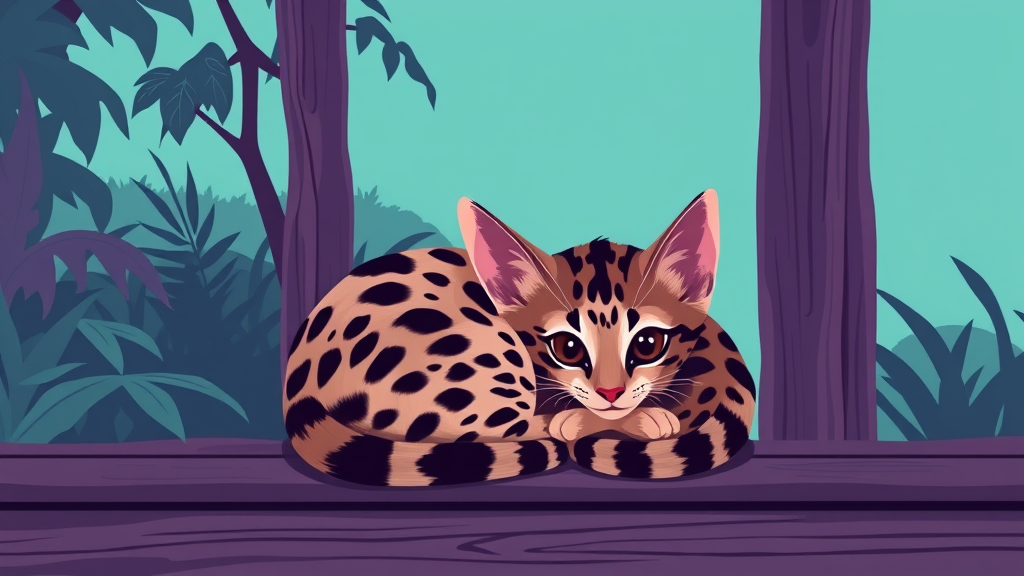

Every so often a discovery starts as somebody's pet. This one started as a small spotted kitten picked up near a forest in Bolivia, the kind of animal a local family might reasonably assume was an unusually marked house cat, or maybe a young ocelot somebody had scooped out of the undergrowth. They kept it. It lived alongside people. And for a while, that was the whole story: an odd little cat with big eyes and a coat that didn't quite match anything in the field guides.
Then the DNA came back, and the field guides needed a new page.
Researchers have now confirmed that the animal belongs to a previously undescribed species of small wild cat, the first new wild cat species recognized in over a century. A century. We've mapped the genome, put cameras on every trail in the Amazon, tagged jaguars from helicopters, and in all that time an entire species of cat was sitting in someone's yard in Bolivia wearing a collar of ambiguity. MSN has the full account, and I've read it three times now, partly for the facts and partly because I keep snagging on the same detail.
What gets me is that the cat was physically there. Visible. Purrable, presumably. It wasn't hiding in a cave system or drifting through the hadal depths of some trench. It was living in the overlap zone between human settlement and forest, which is exactly where nobody thinks to look for a new species because obviously everything there has already been catalogued. Obviously.
The genetic work shows the new species is distinct from its closest relatives, the small spotted cats of South America, the oncilla and its kin, animals that look so similar to each other that even experts have historically struggled to tell them apart from pelt markings alone. That resemblance is probably why this cat went unnoticed so long. It didn't hide. It just looked like a slightly wrong version of something we already had a name for, and a slightly wrong version of a known thing is the easiest thing in the world to walk past.
And now the uncomfortable part, the question the researchers themselves keep circling: nobody knows if any others exist. The holotype, the individual that defines the species, may have been found precisely because it was already outside the forest, already in the human margin where it could be noticed. How many are still in there, in that Bolivian forest, doing whatever this species does at night? No one can say. There's no population estimate. There may not be a population to estimate.
Think about what that means for the way we talk about extinction. We usually frame it as losing something we knew. This is the stranger inverse: a species that entered the scientific record and the possible exit ramp at nearly the same moment, discovered and possibly already rare to the point of vanishing, and we'd never know which came first. It's the saola problem, the thing I wrote about last year, an animal that gets announced to the world already wearing a question mark.
I keep thinking about the family, too. For years they had a living unidentified species eating out of a bowl. There are people reading this who own cats, and I'd put money on at least a few of you pausing to look at your own cat a little longer tonight. Probably fine. Probably.
The boring explanation for this whole story is that the forest is simply undersurveyed and there are plenty more of these cats out there, and I hope with everything in me that the boring explanation wins this time. It usually does. But I've been doing this long enough to know that sometimes the boring explanation wins in the worst possible direction, and until someone camera-traps that forest properly, the answer is out there in the dark, small and spotted and unnamed by anyone who's seen it.
Comments (0)
Log in or sign up to join the conversation.
No comments yet. Be the first.