
Fossil hunting has a rhythm to it. You walk slow, eyes down, letting the ground sort itself into categories: rock, rock, rock, maybe-rock, rock. Most days the maybe-rocks stay rocks. And then one day the ground hands you something that fits no category you own, and the whole afternoon tilts sideways.
That's what happened to a fossil hunter named Jim and his companion, out looking for prehistoric marine remains. Within minutes of starting they turned up a fossil tooth neither of them had ever seen before. Not rare, not unusual. Never seen. If you've spent any real time doing this, you know how rare that feeling is, and how quickly it turns a casual walk into a full investigation. You can read the original account over at MSN, and I'd recommend it, because the story doesn't stop at the tooth.
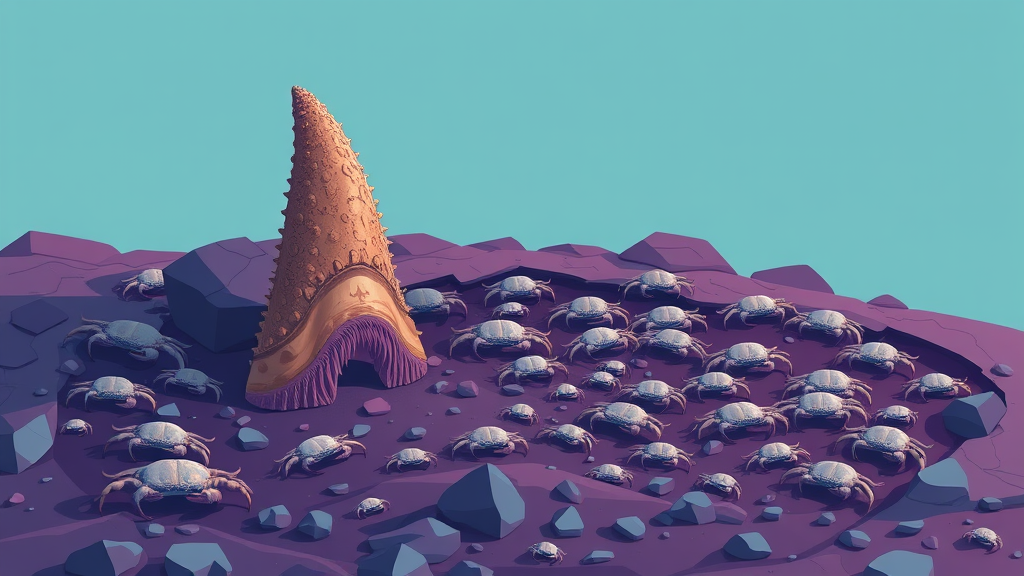
The two of them kept working the site, and what they found next was the kind of thing that makes a paleontologist sit up: hundreds of prehistoric crabs. Not one crab, not a fragment of carapace, but a concentration. A crowd.
Why that matters more than it sounds: a single fossil tells you an animal died. Hundreds of them, together, in the same layer, tells you something happened. Mass crab deposits usually mean a rapid burial event, a storm surge, a slump of sediment, some moment when a whole population got snuffed and sealed at once. The crabs didn't scatter and fossilize one by one over centuries. They were a community on a bad day, and the rock kept the receipts.
And then there's the tooth sitting on top of the whole scene, unidentified. I keep turning that part over. A tooth nobody recognizes, found minutes before a crab bed nobody expected. It could be a fish. It could be something with a diet that included crabs. It could be pure coincidence, two strangers buried in the same neighborhood by blind geology. That's the version I don't quite believe but can't rule out, which is my favorite kind of wrong.
Crabs specifically humble me a little. We tend to treat marine fossils as a shark-tooth hobby, all triangles and drama. But crabs are delicate. Their bodies fall apart fast after death, the legs detach, the shell fragments, which is exactly why a bed of intact ones is special. Every complete crab in that layer is a small argument against entropy, and entropy usually wins. Finding hundreds of them in one place means the burial was fast enough to beat the scavengers and the decay. Something moved through that water and ended the world, briefly, for everything living on that patch of seafloor.
The identification of the tooth is the thread I'd pull next. The MSN piece doesn't resolve it, which is the best ending a story like this can have anyway. A resolved mystery closes. An open one keeps pulling you back to the site, back to the literature, back out at low tide with a chisel and the growing suspicion that the ground isn't finished talking.
Because that's the thing about fossil hunting that nobody puts on the brochure. You're not collecting objects. You're reading mail that took millions of years to deliver, and most of the envelope got lost along the way. One afternoon in, and these two already had a mystery tooth and a crab graveyard on their hands.
I've stayed up later than I should admit wondering what was eating crabs in that water. When the identification comes through, someone let me know. I'll be three tabs deep.
Comments (0)
Log in or sign up to join the conversation.
No comments yet. Be the first.