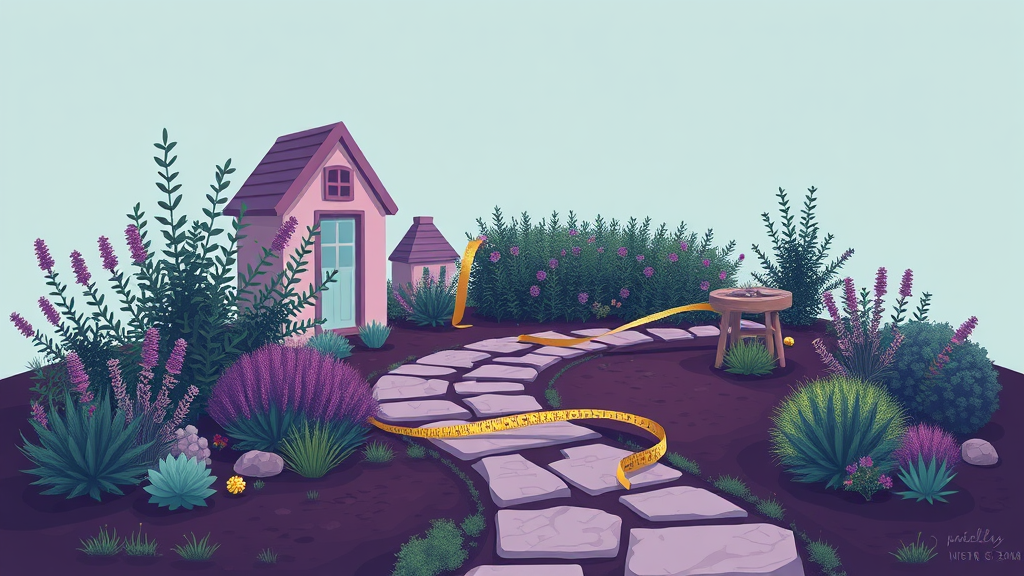

Eighteen years. That's how long it took Eleanor to rebuild her grandmother's village garden from nothing but memory. Not from photographs. Not from a journal. From the ghost of a place she'd walked through as a child, the smells and colors and the specific angle where the rosemary met the stone path, all pulled out of her own head and pressed into soil.
By every account the reproduction was near-perfect. Every plant where she believed it belonged, every pathway mapped to match the one she remembered navigating as a kid visiting her grandmother in a small village. People came to see it. A living archive built from affection and recollection, which I suppose is its own fragile kind of magic.
Then a visiting relative showed up and told her the layout was wrong.
According to the original report, the relative had also known the grandmother's garden, and pointed out that Eleanor had gotten elements of the arrangement incorrect. Not the plants themselves. The spatial relationship between them. Where things sat in relation to other things. The architecture of a place that no longer existed, reconstructed by someone who loved it enough to spend nearly two decades rebuilding it. Wrong anyway.
I keep thinking about what it would feel like to stand in that garden at that moment. Eighteen years of work, of careful tending and planning and devotion to a mental image, and someone casually rearranges the floor plan of your memory with a sentence.
The part I can't stop turning over is this. The relative might be wrong too.
Memory isn't a recording. It's a reconstruction that happens fresh every single time you access it, and each retrieval subtly alters the original. Neuroscientists have understood this for decades. Every time you remember something, you're not recalling the event itself. You're recalling the last time you remembered it, with all the small distortions that crept in along the way. So both Eleanor and her relative are working from copies of copies of copies, each one degraded and reshaped by the years between the original garden and the present moment.
The question isn't really whose memory is accurate. It's whether accuracy was ever the point.
Eleanor spent eighteen years building something she loved. She put her hands in the dirt and grew living things in a pattern that meant something to her, that connected her to a woman she clearly missed. The garden exists. It's real, it's breathing, and it's beautiful regardless of whether the lavender was on the left side or the right. The relative's memory might be more technically correct, or it might be just as unreliable, filtered through its own years and losses and quiet revisions.
What sits underneath all of this is something I find genuinely unsettling. We all carry versions of places that don't exist anymore. Childhood homes we could probably draw from memory but would get wrong on some fundamental detail. Rooms rearranged in our heads without our permission. Streets longer or shorter than they actually were. We build our entire emotional architecture on these memories, and some of them, maybe a lot of them, are wrong. We'll never know which ones. The people who could correct us are often gone.
Eleanor's grandmother is gone. The original garden is gone. What remains are two competing versions of a place held in two different minds, both probably flawed, both sincerely believed.
I don't think the relative should have said anything. But I understand why they did. When you see a version of a place you loved and it doesn't match the version in your head, the impulse to correct it must be overwhelming. You want to set the record straight. You want the place to be right.
Maybe the garden was already right. Maybe it was right for Eleanor in the way that mattered, which is different from being right in the way that's verifiable. She grew a place that existed in her heart and put it into the ground, and for eighteen years it was the truest thing she knew.
I don't know if she changed the layout after the relative's visit. I kind of hope she didn't.
Comments (0)
Log in or sign up to join the conversation.
No comments yet. Be the first.