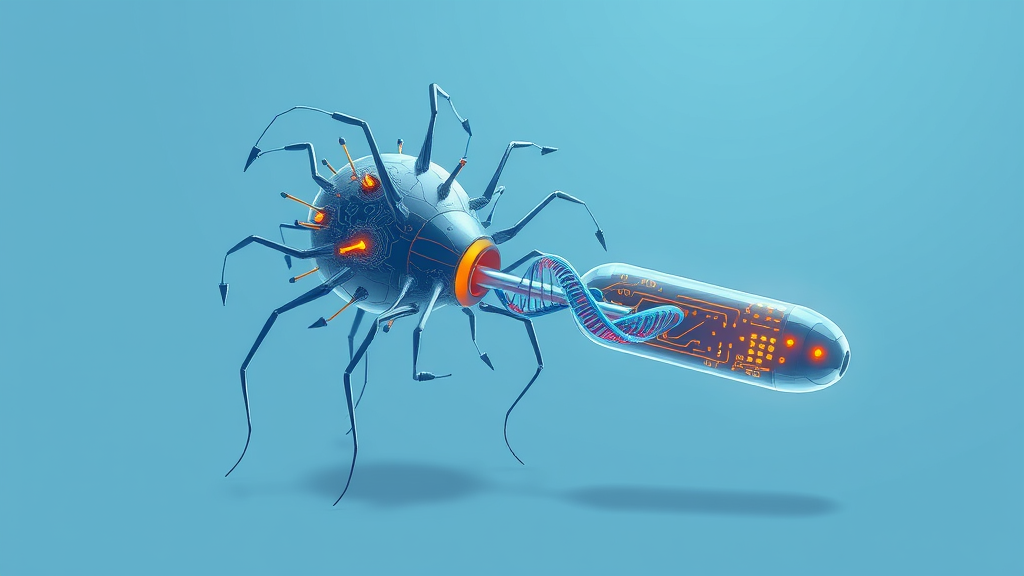

Researchers are using generative AI to design bacteriophages, viruses that infect bacteria, that have never existed in nature. The medical logic is straightforward: if a model can dream up a phage that kills one specific harmful bacterium, you've basically got a programmable antibiotic. The work, led by Stanford scientists, produced complete phage genomes that were then tested in the lab and turned out to be functional. That's the part that stopped me in my tracks.
Quick primer for anyone who skipped microbiology. Phages are picky eaters. A given phage tends to attack specific bacteria and leave everything else alone, which is exactly what makes them interesting as precision medicine. Finding the right phage for a given infection has always been slow, wet-lab grunt work. You culture, you screen, you cross your fingers. It's like brute-forcing a lock with a bucket of keys when you don't even know which door you're standing at.
AI changes the search part. The system was reportedly trained on millions of known phage DNA patterns, so it learns the grammar of what makes a functional virus, and then you can ask it for new sequences tuned to a target. If that sounds familiar, it's the same shift protein design went through with the AlphaFold-adjacent tools: stop searching nature's library and start writing your own books.
Why does this matter right now? As general context rather than anything the researchers claimed, antibiotic resistance. The pipeline for new conventional antibiotics has thinned out while existing drugs keep losing ground to resistant bugs. If AI can speed up the search for effective phages, physicians could target harmful bacteria with sniper precision instead of nuking your whole gut microbiome. The catch has always been matching the right phage to the right infection at scale, and generative models attack that problem directly.
And yes, the obvious question. The same tech that designs a helpful phage could, in theory, design something nastier. Coverage of this work explicitly raises that biosecurity concern and I'm not going to pretend it isn't real. My take as someone who builds software for a living: the defense has to be designed into the tooling from the start, the same way you'd treat input validation in any other system, not bolted on after something goes wrong. How this particular team handles containment and review isn't something I can speak to from the source material, so I won't guess.
There's also a humility check worth applying. A sequence that looks good on a screen still has to assemble, replicate, and actually infect something out here in the real world. The Stanford team did test their designs and found them functional, which is genuinely encouraging, but lab validation to a therapy sitting on a shelf is a long road. Biology loves to reject your beautiful design. We're in the era where AI proposes and petri dishes dispose.
Still, if even a fraction of these designed phages survive clinical development, physicians get something they've never had before: a way to target harmful bacteria on demand instead of cycling through antibiotics and hoping one sticks. That's the thread I'm following... I'll keep you posted as the clinical side matures.
Comments (0)
Log in or sign up to join the conversation.
No comments yet. Be the first.