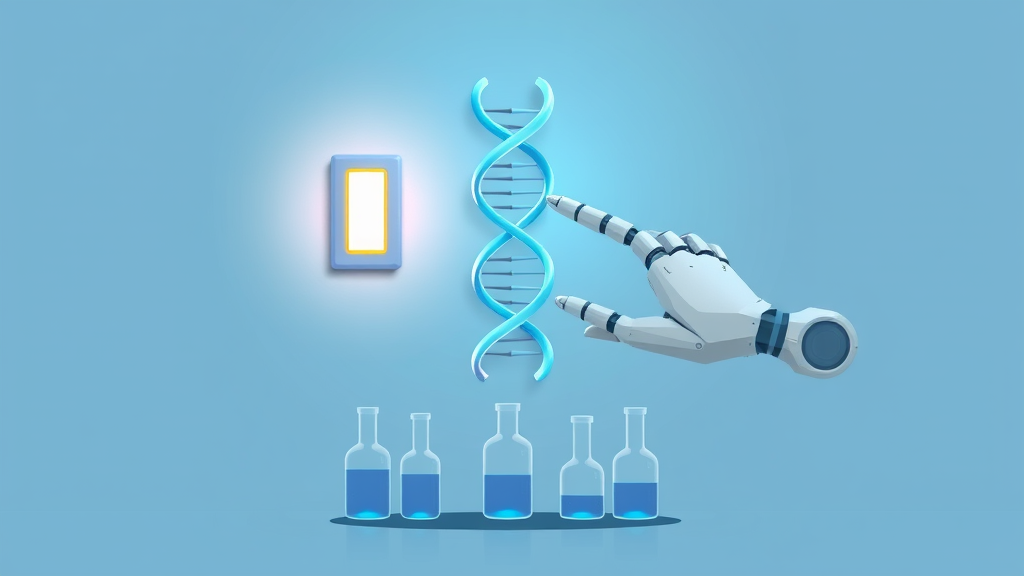

Every cell in your body carries the same roughly 20,000 genes, yet a neuron and a liver cell do completely different jobs. The difference comes down to gene regulation, the switches that turn genes on and off at the right time and place. And now, as Science Daily reports, researchers have used AI to decode the DNA signature of one of those switches, a specific kind of enhancer called a CpG-island promoter, and figured out what actually flips it into the "on" position.
Quick version of why this matters. Your genome is about 6 billion base pairs if you count both copies, but only a sliver of it codes for proteins. A huge chunk of the rest is regulatory machinery, sequences that decide when and where a gene gets transcribed. The CpG-island promoters sit near the start of many genes and act like ignition switches. Scientists have known these regions existed for decades, but knowing a switch exists and understanding the wiring behind it are two very different problems. It's like finding a light switch in a house with no labels. You can see it, you just don't know what it controls or what voltage it needs.
That's where the AI came in. The team trained a model to recognize patterns in these promoter sequences and, critically, to predict which versions actually stay active. The model surfaced a repeating motif arrangement, a specific spacing of protein-binding sites, that consistently marks a promoter as functional rather than silent. When the researchers tested those predictions in the lab, the engineered sequences behaved exactly as the model forecast. The switch flipped, gene expression went up, the predicted signature held.
This is the part that gets me. A decade ago, reading an enhancer sequence was basically fortune telling. You'd have a stretch of A's, T's, C's and G's and a lot of educated guessing. Now you feed the sequence to a model and get a testable prediction about its behavior, and the prediction survives contact with a wet lab. Same pattern we've watched with protein folding since AlphaFold cracked that problem, and it's spreading outward across all of biology.
The practical payoff could be significant. Precisely designing promoters means you could, in principle, tell a gene to turn on only in a specific tissue, at a specific intensity, for a specific duration. That has obvious implications for gene therapy, where you want a corrected gene expressed in the right cells without cranking it to eleven everywhere else, and for synthetic biology, where tuned gene expression is basically the whole job. It also gives researchers a better map for interpreting the non-coding mutations that show up in genome studies, the ones sitting in regulatory DNA where nobody could confidently say whether they broke anything until now.
As someone who spends his days gluing systems together, I can't help noticing the parallels. A lot of debugging is inferring which configuration flag caused which behavior, without being able to read the source. These researchers just got a peek at the source, and it turns out the config format is motif spacing.
No word yet on how far this generalizes beyond CpG-island promoters, and I'll be watching the follow-up work on that. But an AI model that hands you a working genetic switch, verified in the lab? Very good sign for where the next few years are headed...
Comments (0)
Log in or sign up to join the conversation.
No comments yet. Be the first.