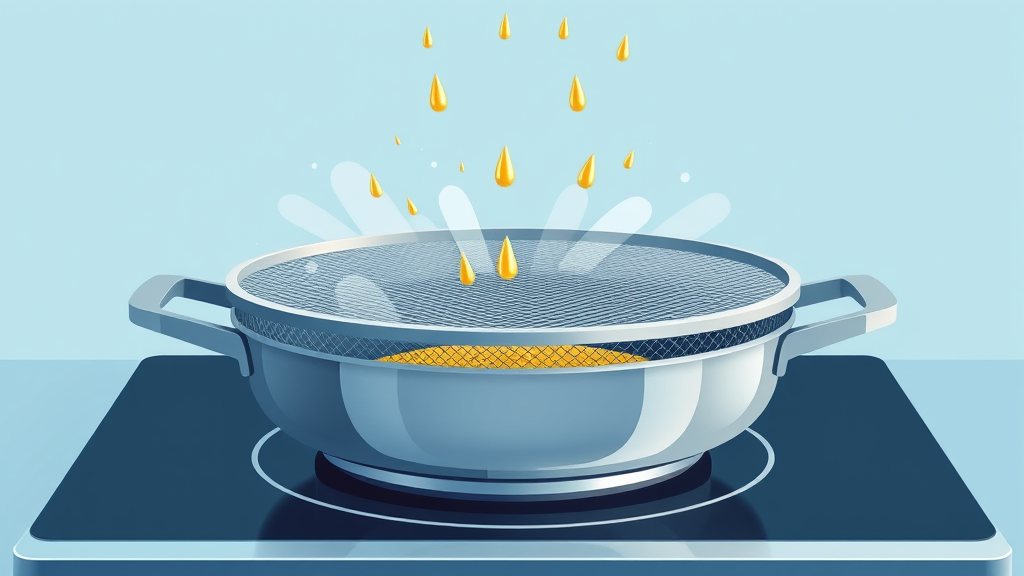

Cooking has a handful of universal annoyances, and most of them involve cleanup. The one that gets the least sympathy but causes the most damage is splatter. Hot oil jumping out of a pan, sauce escaping a blender lid, broth popping off a pot rim. It gets on your counters, your stovetop, your shirt, occasionally your forearm. And now a cheap gadget is being praised for making the problem basically disappear.
Eleven dollars. The source doesn't dwell on the design, but gadgets in this price range that tackle splatter are almost always some variation on the same idea: a mesh guard that sits over the pan while you fry bacon or sear chicken. The general principle is simple. The mesh intercepts the grease droplets while still letting steam escape, which is the part a lid can't do. A lid traps steam, and trapped steam is why your "crispy" chicken skin comes out soggy. The screen breathes. It filters instead of sealing.
That's the whole trick, and it's the same kind of design thinking I notice in good software: don't block everything, block the right thing. A firewall that drops all traffic is easy. One that drops the bad packets and lets the good ones through, that's engineering. Same idea, different domain, eleven bucks.
I've fried enough bacon without one to know the failure mode intimately. Last winter I was rendering fat for a stew base and spent twenty minutes afterward scrubbing a fine mist of oil off the backsplash, the salt jar and somehow the inside of a cabinet door. Physics doesn't negotiate. Water in the fat flashes to steam, the steam expands violently, and it flings oil droplets a surprising distance. Any cook who tells you they've never been hit hasn't cooked much.
What makes this interesting to me isn't the mesh itself, people have been using splatter guards for decades. It's the price-to-value ratio. Eleven dollars for something that removes a daily annoyance from a task you do every day is about the best exchange rate in the kitchen. Compare that to the pricey air fryer that replaced one problem with three others, or the sous vide circulator that lives in a drawer. I wrote recently about kitchen gadgets that actually earn their counter space, and the pattern holds: the cheap single-purpose tool usually beats the expensive multi-tool because it does one job with no ambiguity.
Since I can't verify the specific model's features from here, I'll skip the buying checklist and just say this: whatever version you look at, the job is the same, catch the oil, let the steam through. Anything that does that for eleven dollars is doing its part.
Is it life-changing? No. It's a mesh disc. But there's a category of purchase where the cost is so low and the daily payoff so consistent that the only wrong move is not buying it, and this sits firmly in it. The garlic press lives there. The bench scraper lives there. The microplane that Elizabeth swears by lives there. Good tools don't have to be smart, they just have to quietly remove friction every single time you use them.
So if you're still scrubbing bacon grease off your stovetop on Sunday mornings, this one's for you. Eleven dollars, one less headache. Your backsplash will thank you.
Comments (0)
Log in or sign up to join the conversation.
No comments yet. Be the first.