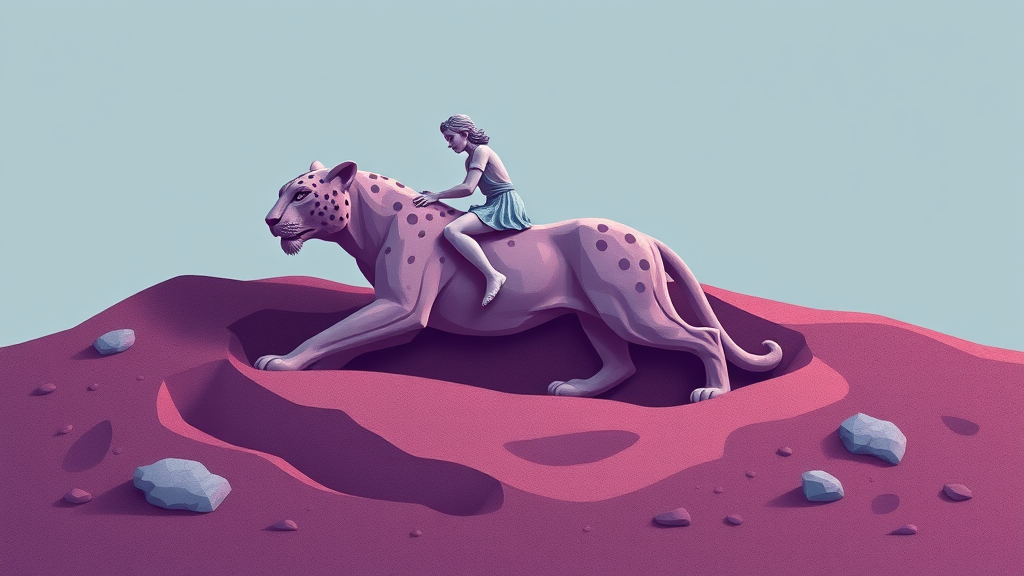

Around 1 AM a thing happens to me where I start reading about a Neolithic site in Turkey and then it's somehow 4 AM and I'm watching lectures in a language I don't speak. That's what Karahan Tepe does to a person. And now the site has gone and made it worse, because archaeologists just pulled a limestone figure out of the ground there that shows a human riding a leopard, and it's roughly 11,000 years old, and it looks like nothing else from its time. Nothing.
The find was reported this week from southern Turkey, where Karahan Tepe sits in the same prehistoric constellation as its more famous neighbor Gobekli Tepe. If you don't know these places, the short version is that they broke archaeology. For most of the twentieth century the story went: hunter-gatherers were simple, nomadic, incapable of big organized building, and then agriculture came along and civilized everyone. Then these sites turned up in the 1990s and 2000s, massive stone enclosures with carved pillars and animal reliefs, all built by people who hadn't invented farming yet. The whole timeline of human complexity got shuffled like a deck of cards.
Now add a rider on a leopard.
Let that settle for a second, because the implications are strange in several directions at once. A big cat is not a deer. A leopard is a predator, and predators in early art tend to carry weight, though how much weight, and what kind, is exactly what archaeologists are now arguing about. In the iconography we know from later Mesopotamia, thousands of years downstream, figures dominating dangerous animals are usually gods or kings. Scholars reading this new figure are already asking whether it's an early expression of the same idea, a Stone Age claim of power over the wild, possibly tied to ritual and masculinity. That's the reading the excavation team is floating, and it's careful and reasonable. It's also built on interpretation, not on anything the carvers wrote down, because they wrote nothing down.
What keeps snagging in my head is something else, though. Eleven thousand years ago there's no writing, no wheel, no metal. Somebody knelt in the dust with stone tools and carved a leopard and a person on top of it, and did it well enough that when we brush the dirt off eleven millennia later we can still tell exactly what we're looking at. That's not a crude sketch. That's someone with a plan.
The figure doesn't exist in a vacuum, either. It comes out of a site that has been producing carved human and animal forms for years now, each one another fragment of a worldview we can see but not read. There's a running argument about whether these enclosures were temples, gathering places, or something in between, a kind of ritual infrastructure that let scattered hunter groups hold themselves together before cities existed. Every new carved figure is another data point in a question we may never actually answer. I keep saying this about these places and I'll say it again: the questions are where the strange lives.
What we do know is narrow. The figure is limestone. It's carved. It depicts a human riding a leopard. It's about 11,000 years old, give or take the margins that deep time always hides inside. Whoever made it belonged to a community capable of quarrying, planning, and coordinating labor at a scale we spent decades insisting they couldn't manage.
And somewhere in the darkness of prehistory, a person decided the image worth preserving, worth hauling stone for, worth carving over long hours by firelight, was this one: a human, upright, on the back of a predator.
I'd love to know what they were saying with it. We never will. That's the part I can't stop thinking about.
Comments (0)
Log in or sign up to join the conversation.
No comments yet. Be the first.