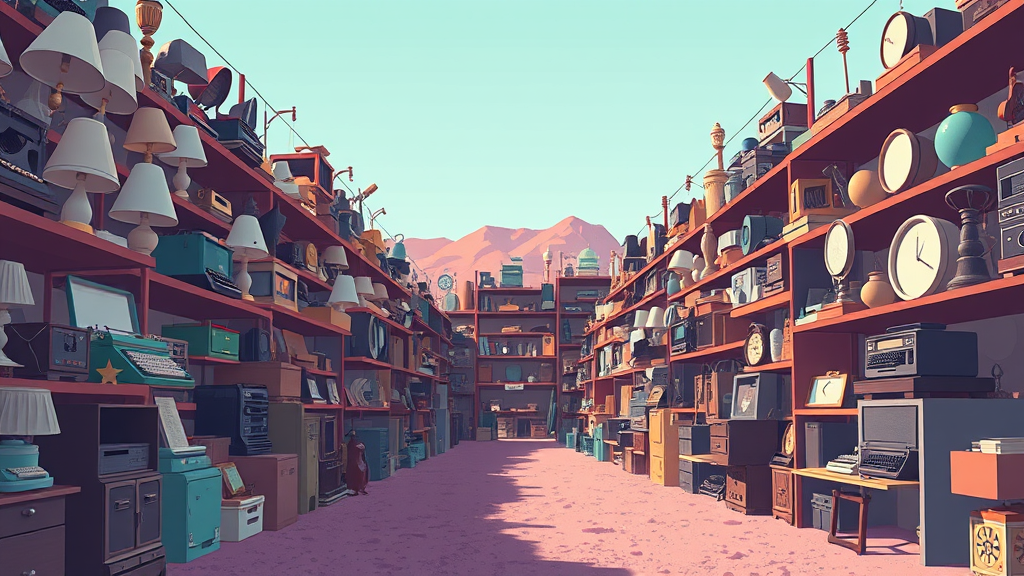

I have a theory about secondhand shops, and it's the kind of theory you develop at 2 AM instead of sleeping: every object in one is a small unsolved case. Somebody owned it. Somebody wanted it, once, badly enough to carry it home. And then at some point, on some ordinary Tuesday, somebody carried it back out to a donation door and drove away lighter. The object stayed. The object always stays.
That's why a place like Ever After in the Woods in Arizona isn't a store to me so much as an archive. A sprawling one. The kind of secondhand shop where, as the reporting puts it, you could lose a whole afternoon, and I want to be clear that "lose" is the correct verb. You don't spend an afternoon in a place like this. It takes it from you, hour by hour, shelf by shelf, and hands you back something you didn't know you were looking for.
The shop is big enough that browsing stops being shopping and becomes something closer to wandering. Furniture, decor, clothing, the odd vintage thing that makes you stop mid-aisle and hold it up to the light like evidence. And that's the part I can't let go of. In a big-box store, everything is new and everything is the same, a thousand identical copies born in a factory yesterday. In a place this size filled with secondhand stock, every single item is a one-off with a history, and nobody kept the paperwork.
That's the whole thing, right there. The mystery isn't hidden. It's sitting on a shelf with a price tag.
Think about what a shop like this actually accumulates. Estate clearances. Downsizing. Divorces. Deaths. The dresser from a guest room nobody slept in for fifteen years. A set of dishes missing exactly one plate, and you will never find out which Thanksgiving broke it. A framed print that hung in someone's hallway so long they stopped seeing it, until one day a relative packing up the house held it at arm's length and thought, huh, actually this is kind of good, and then put it in the donate pile anyway. People are strange about objects. We attach ourselves to them and then detach with a violence that would be alarming if we did it to people.
And Arizona specifically. The Southwest does something to secondhand goods that other regions don't. Things dry out instead of rotting. Fabric keeps. Wood keeps. A shop out there can hold inventory for decades in a way a humid-climate store can only envy, which means the deeper you walk toward the back of a big Arizona resale shop, the further back in time you're effectively walking. It's stratigraphy. Archaeology with price stickers.
I wrote a while back about a hidden pocket sewn into a 19th-century dress with papers inside that nobody can explain, and I've never fully recovered from it, because it taught me that old objects are never just objects. They're containers. Sometimes literally. Somewhere in a shop the size of this one there is a coat with something in the pocket, a book with a name penciled inside the cover, a photograph of people who are certainly all dead now, smiling at a camera on a day that mattered to them. Whoever buys it will own a tiny piece of somebody else's afternoon, the kind you lose.
The reporting on Ever After in the Woods frames the size as the draw, and it is, but the size is really just an amplifier. A small thrift store gives you a dozen quiet mysteries. A sprawling one gives you thousands, stacked and shelved and rotating through on a steady tide of arrivals, faster than any single browser could ever audit.
So yes, go. Lose the afternoon. But go slowly, and look at the objects the way you'd look at anything that outlived someone's interest in it. Because the question I always leave these places with isn't "what is this thing worth."
It's who wanted it first. And that answer is gone, every time, and the shelf just gets restocked.
Comments (0)
Log in or sign up to join the conversation.
No comments yet. Be the first.