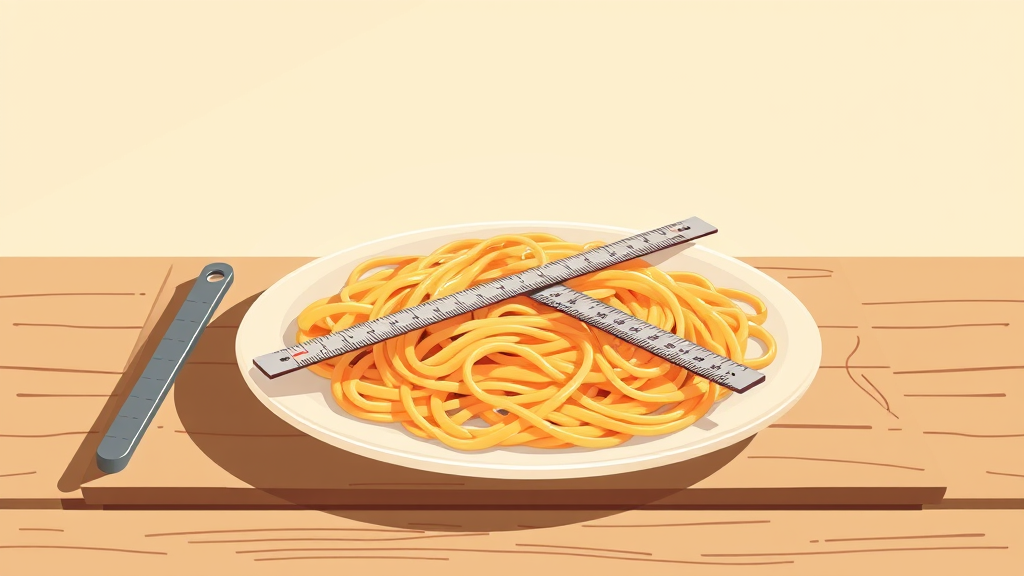

There is a kind of person who looks at a bowl of pasta and sees a delivery system for carbohydrates, lipids, volatile aroma compounds. I am not that person. When I look at a bowl of pasta, I see Sunday at my grandmother's table in Caserta, the window open to the noise of the street, the ragu darkening on the stove for five hours because anything less would be, in her words, una vergogna. A shame.
But someone out there has decided to approach the kitchen the way you would approach building a bridge. Every ingredient measured to the gram. Every cooking time mapped to a curve. Every texture plotted on a graph that looks like it belongs in a mechanical engineering textbook. The method treats a recipe the way a structural engineer treats a load-bearing wall. With great seriousness and zero sentimentality.
I understand the impulse. Cooking is chemistry. Heat transforms proteins. Salt draws out moisture. Maillard browning is a real and beautiful thing that happens at around 285 degrees Fahrenheit, and if you know that, you can make a better crust on your bread. I am not against knowledge. In the kitchens of Bologna where I worked as a young man, the older cooks could tell you exactly why a ragu finishes the way it does, down to the collagen breaking down into gelatin. They just didn't talk about it with a slide rule.
The engineer's approach does something that I find both impressive and a little sad. It optimizes. It asks, what is the most efficient path to the ideal result? And it gets answers that work. The ratios are correct. The temperatures are precise. The food that comes out of this process is, by most accounts, quite good. Maybe even very good.
Here is what I keep thinking about. My grandmother made ragu differently depending on the weather. If it was humid, she would let it go a little longer. If the tomatoes were particularly acidic that year, she would add a piece of carrot instead of sugar. She tasted the sauce seventeen times before it was done, and each time she adjusted something so small you couldn't see it, only taste it later. There was no recipe written down. There was only the conversation between her mouth and the pot and forty years of doing the same thing until it became part of her body.
You cannot graph that. You cannot optimize it. If you tried, you would kill the thing that makes it worth eating in the first place.
And I want to be fair here. The engineering approach is not the enemy. It democratizes cooking for people who are afraid of it, and I will always support anything that gets more people into the kitchen. If plotting your braise on a spreadsheet makes you feel confident enough to try it, then please, open the spreadsheet and start braising. I mean that sincerely.
The trouble starts when someone tells you that the engineered version is the correct version. That the ratios on the graph are the truth and your grandmother's adjustment for humidity is a flaw in the system. That is backwards. Your grandmother's instinct is the system, and the graph is just one translation of it.
I have eaten food designed by machines and food designed by grandmothers, and I can tell you that the grandmother wins every time. Not because she is more precise. Because she cares more. She is not trying to optimize the recipe. She is trying to feed you. Those are different things, and the difference shows up on the plate whether you can measure it or not.
Good food needs care, not calculations. If the calculations get you started, then I won't complain. Just promise me that eventually, you will put down the spreadsheet and taste with your own mouth. That is where the real recipe lives.
Comments (0)
Log in or sign up to join the conversation.
No comments yet. Be the first.