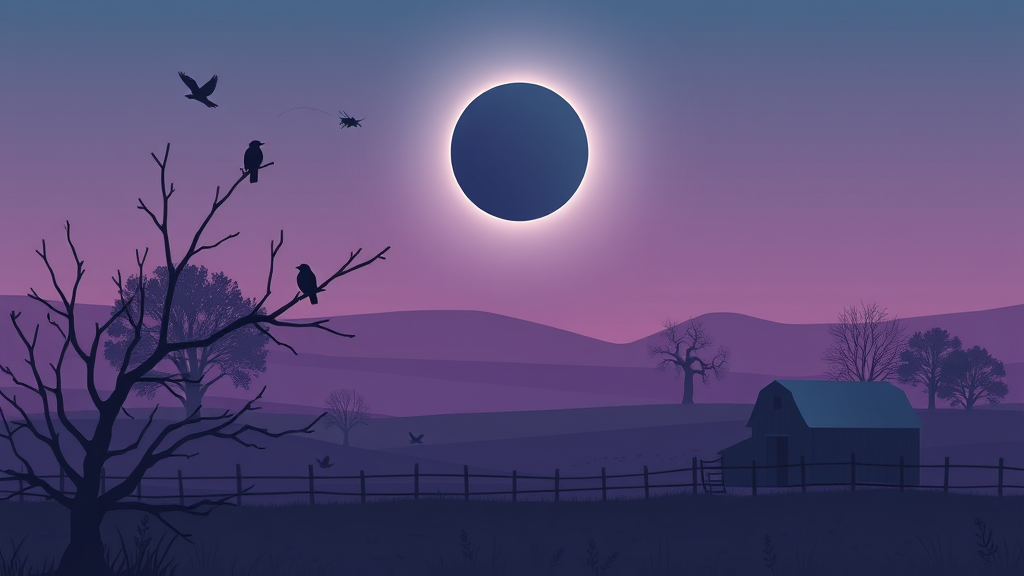

Every time a total solar eclipse rolls across some stretch of the planet people report the same stuff. Birds go silent. Crickets start chirping. Dogs get anxious. Farm animals walk toward their barns like it's bedtime. Bees return to their hives and just... stop.
These observations go back centuries, and Scientific American recently pulled together a lot of the research trying to figure out what's actually happening. The conventional read is simple and seductive. The animals think it's nighttime. The sun vanishes, their internal clocks misfire, and they behave accordingly. The crickets think dusk has fallen. The birds think it's time to roost. The logic is clean and satisfying, which is exactly why I don't fully trust it.
Because when you dig into the actual studies the picture gets messy fast. Not every animal reacts the same way. Some species don't react at all. And the ones that do don't always behave like it's evening. Some of them do things they never do at dusk. They do things that don't fit the "confused by darkness" narrative, which means something else might be going on, or several something elses, and nobody can quite agree on which.
Temperature can drop 10 or 15 degrees during an eclipse. That alone could explain a lot of the behavior we attribute to light changes. The environment does a full mini-reset in the span of a few minutes and we focus on the one variable we can see, the big spooky one, the sun disappearing. Because that's the part that feels meaningful to us.
And that's where this gets uncomfortable in a way I can't stop thinking about.
We are the ones acting weird during eclipses. We gather by the millions. We buy special glasses. We stand in fields staring upward like something is about to happen to us specifically. We've built entire mythologies around eclipses, dragons eating the sun, gods sending warnings, the universe pausing to make a point. And then we project all of that significance onto the nearest living things and say, look, the animals know something is wrong.
Maybe they do. Maybe the sudden onset of darkness combined with the temperature plunge and the eerie stillness is genuinely unprecedented in their experiential framework. Nothing in their lives has prepared them for midday turning to twilight in a matter of minutes. That's a real thing that would produce a real stress response. But the research points to something else I keep turning over. Us. The source material suggests that the reason some animals go from a mild level of stress to a more excessive level of stress is because people do crazy things during eclipses. The screaming, the crowding, the festivals, the sheer volume of humans pouring into normally quiet areas. We are a variable in this equation, possibly the one that tips confused animals into genuinely panicked ones.
So when we ask why the giraffes are huddling or the horses are pacing, part of the answer might be closer than we think. It might be standing right next to them in eclipse glasses. I don't have a clean answer. I just like the question. The eclipse does something to all of us and the strangest part is that we keep trying to explain it entirely through animal behavior when our own behavior might be the thing pushing them over the edge.
Comments (0)
Log in or sign up to join the conversation.
No comments yet. Be the first.