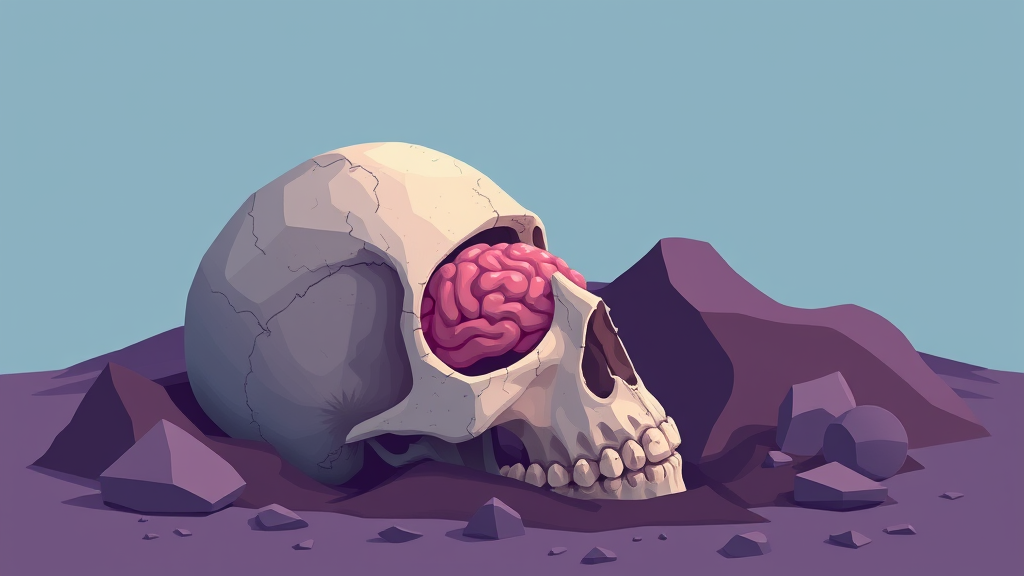

A fact I stumbled onto at about 1 AM last week and still haven't put down: the human brain is, by every reasonable expectation, the first soft tissue to go when you die. Roughly 80 percent water, the consistency of soft tofu, and it starts decomposing within hours. And yet archaeologists have now catalogued more than 4,400 human brains sitting intact inside skeletons whose everything else, skin, muscle, tendons, eyeballs, the lot, dissolved centuries or millennia ago. Just the brain. Sitting there like it was waiting.
A team led by forensic anthropologist Alexandra Morton-Hayward actually counted these things, going through four centuries of archaeological literature in multiple languages to build the largest database of preserved brains ever assembled. The catalog runs to over 4,400 specimens, some of them 12,000 years old, pulled from peat bogs in England, shipwreck sediment, deserts, mass graves, and ordinary churchyard cemeteries where nothing about the burial conditions should have preserved anything at all. That last category is the one that keeps me up. A skeleton in dry soil, no bog acids, no freezing, no amber-like sealing, and inside the skull: a recognizably folded, shrunken, intact brain.
For decades the standard assumption was that these were flukes. A brain preserved here or there under freak conditions, everything else contamination or wishful thinking. Morton-Hayward's database wrecked that idea, because 4,400 isn't fluke territory, and because so many of the brains turned up in conditions that shouldn't preserve anything. So the question flipped: instead of asking why these brains survived, the field had to ask what the brains themselves were doing.
The answer, laid out by Morton-Hayward and colleagues, is that the brain appears to preserve itself. When the body dies and the brain's own immune cells activate, they release iron in large quantities. Brain tissue is also loaded with lipids, fats, that can fuse and cross-link with that iron and with proteins to form a tough, hydrophobic, slightly rubbery mass. Think of it as the brain cooking its own preservation stew from the inside. The iron and lipid chemistry effectively welds the tissue into something decomposition microbes can't easily digest, and in the right conditions, a skull acting as a sealed ceramic container, low oxygen, the right moisture, that welded mass can outlast bone-adjacent soft tissue by thousands of years.
The wild part is what's inside some of them. Several of the preserved brains have yielded intact proteins, and in a few cases fragments of ancient DNA, from people who died five or ten thousand years ago. A tissue type we assumed was the most perishable thing in the body turns out to be, under specific conditions, one of the most durable. Researchers are now talking about these brains as a largely untapped archive for studying ancient diseases, evolutionary changes in the brain, and the biology of people who left no written record. We spent centuries sawing open skulls and tossing the shriveled thing inside because we assumed it was garbage. Some of it was a time capsule.
And there's a detail from the database I can't shake. The preservation seems to happen across wildly different environments, hot and cold, wet and dry, which suggests the mechanism is less about where you're buried and more about what your own brain chemistry does in the hours after death. Which means, statistically, there are almost certainly far more of these sitting in the ground and in museum storage basins than 4,400, mislabeled or unnoticed. Somewhere right now there's probably a jar on a back shelf labeled 'sediment sample' with a twelve-thousand-year-old mind floating in it.
The full writeup is over at MSN, and it's worth reading with the lights on, if only because the mechanism is genuinely more unsettling than the mystery was. I've said before that I love the questions more than the answers, but every so often the answer arrives and it's stranger than the question deserved. Your brain's last act, if the chemistry cooperates, is to build its own coffin. I need to go to bed.
Comments (0)
Log in or sign up to join the conversation.
No comments yet. Be the first.