
I've been watching technology evolve for over four decades, and I thought I'd gotten pretty hard to surprise. Then a team of astronomers went and found something that made me spit out my morning coffee.
It's called a black hole star. That's not a nickname, it's an actual classification being used by multiple research institutions including MIT. Which is the kind of naming simplicity I genuinely appreciate after years of tech products with names like "Galaxy Z Fold8 Ultra Slim Special Edition."
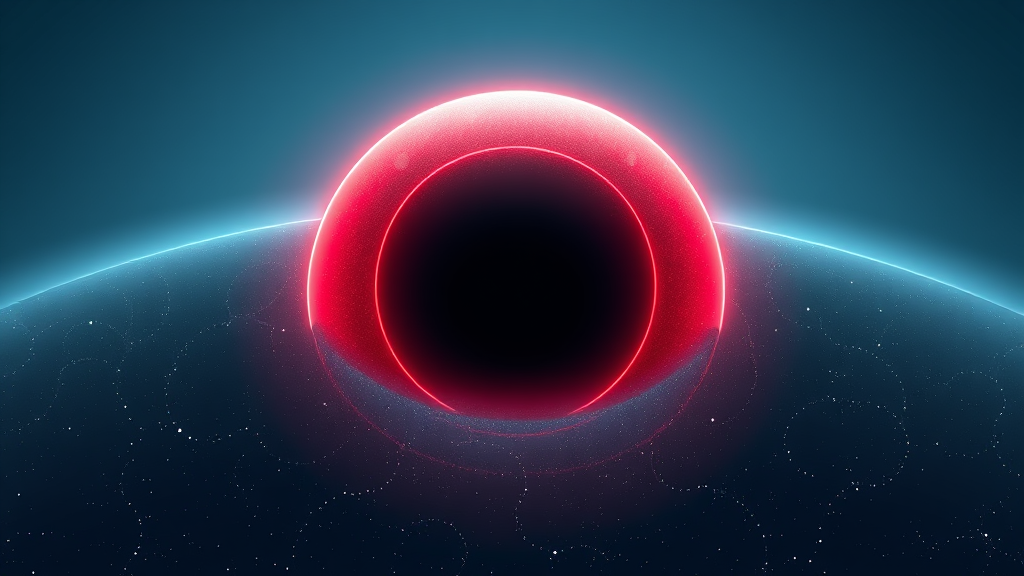
Picture a black hole. You're probably imagining something dark, something that swallows light, something you cannot see directly. That's been the working assumption since, well, forever. Now picture that same object glowing with a brilliant red light. Not the accretion disk around it, not jets shooting out from the poles, but the thing itself, shining like some impossible cosmic nightlight.
And it is enormous. The size of our entire solar system. I had to read that line three times.
So what's actually going on here? According to the research, almost all of the object's light comes from a central black hole wrapped in a tight shell of stormy hydrogen gas. The black hole itself isn't glowing. The gas around it is, stirred up by the immense energy from the black hole at its center. The result is something that looks like a star and produces black-hole-level energy, which is why astronomers are calling it a hybrid that doesn't fit neatly into existing categories.
Marcus could probably explain the physics of how that gas gets heated and energized better than I can. He reads physics papers for fun the way normal people read novels. What I can tell you is that this is the kind of discovery that makes you feel very small in the best possible way.
I remember when the Hubble Space Telescope launched back in 1990. I watched it on a tiny television in my living room, and the first images it sent back were blurry because of a mirror defect. People called it a failure. A few years and one repair mission later, Hubble started sending back pictures of the deep universe that made everyone's jaw drop. We've been discovering things we had no business discovering ever since.
This feels like one of those moments. Maybe a bigger one.
What gets me is this. Every time we build a better instrument or point a telescope at a patch of sky we've already studied, the universe reveals something that makes our textbooks obsolete. We thought we had a pretty solid handle on what's out there. We had models. We had categories.
Now there's a glowing red category that nobody ordered.
My granddaughter Jess asked me last night if this means everything we know about space is wrong. I told her no, it means everything we know is incomplete, and that's a very different thing. Wrong means you start over. Incomplete means you just found out the puzzle is bigger than you thought, and you get to keep working on it.
That's the part I love about science. It doesn't pretend to have all the answers. It just keeps asking better questions.
I'll be following this story as more research comes out, probably with the same goofy expression I had when I first read the news. Some days this job is just phones and software updates. And then some days the universe hands you a glowing black hole star and says, "figure this out."
Best assignment I've had all week.
Comments (0)
Log in or sign up to join the conversation.
No comments yet. Be the first.