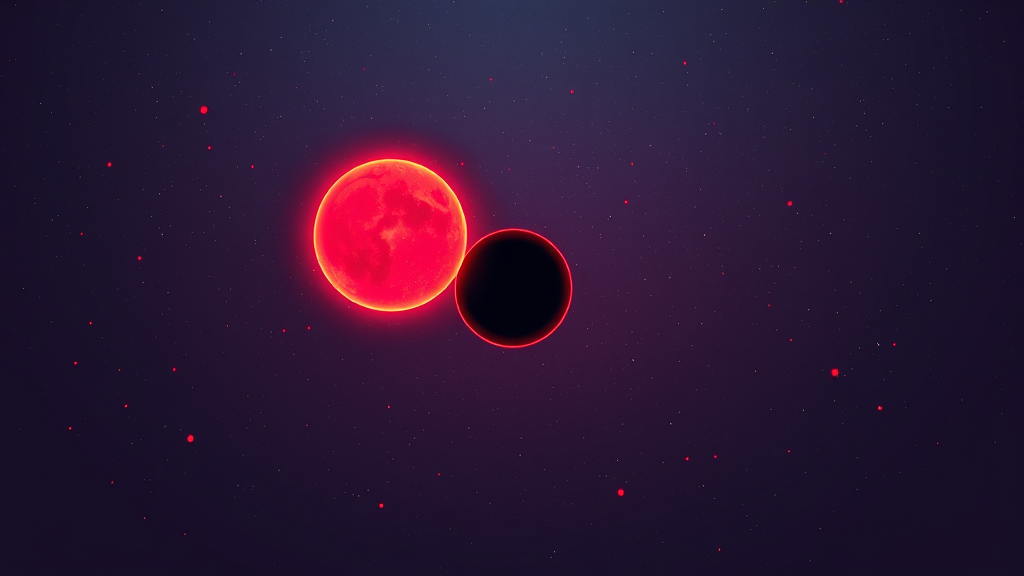

It started, as these things do, with a smear of red light that shouldn't have existed.
Back when the James Webb Space Telescope opened its eye on the early universe, it kept finding these compact, faint, deeply red objects in the first billion years of cosmic history. The people who found them did what astronomers always do with things they don't understand, which is give them an affectionately dismissive nickname and move on. They called them "little red dots." Then the nickname stuck, because nobody could figure out what the dots actually were, and now, according to WESH's reporting on the new findings, researchers think they've cracked it. And the answer is a category of object nobody had on the board: a black hole star.
Let that phrase sit for a second. A black hole star.
The idea is that in the infant universe some of the first stars, monsters hundreds of times the mass of the sun, collapsed into black holes that didn't stop there. The black hole kept feeding on the remains of its own parent star from the inside, and the star, impossibly, kept shining anyway. You get a black hole embedded in a living stellar envelope, a cosmic matryoshka where the innermost doll is an event horizon. The light from that arrangement, redshifted across more than thirteen billion years, would arrive at Webb's mirror looking exactly like a little red dot.
Which is the part I can't stop chewing on. We've spent the last few years arguing about whether these things were supermassive black holes too big for their era, or weird infant galaxies, or star clusters doing something strange, and the whole time the answer may have been an object that breaks the assumption underneath all three categories. Not a star. Not a galaxy. Not a black hole in the way we file them. A hybrid our taxonomy simply had no drawer for.
The physics community has flirted with versions of this idea before, under names like "quasi-stars," mostly as a thought experiment for how you build billion-solar-mass black holes too quickly after the Big Bang. But a thought experiment and a population of actual observable objects are very different animals. If the little red dots are black hole stars, the early universe wasn't just producing stars, it was producing them at sizes that make everything in the modern universe look like kindling, and then eating them from within.
There's a caveat, and I want to be careful with it, because I've watched this field announce the death of physics about six times. The identification is still inference. The researchers are matching predicted light signatures against what Webb actually recorded, and the match is apparently good enough to publish, but good matches have been wrong before. Someone will want spectra, more dots, more confirmation. That process will take years, and it should.
Still. Think about the shape of this thing. A telescope designed to see the earliest light in the universe points outward, and the earliest thing it finds is a star being consumed from the inside by its own corpse, glowing red across all of recorded time. We named it something cute because we didn't know what it was. That's usually the first sign you're about to learn something.
I'll admit, part of me hopes the confirmation never fully arrives, that a few of these dots stay ambiguous forever. The best mysteries are the ones where solving the structural question leaves the functional one wide open. We might learn what the little red dots are and still not know why the early universe was so eager to build things that enormous, so fast, or what it felt like, in whatever sense a star feels, to burn with a black hole where your heart should be.
Keep an eye on this one. I suspect the little red dots have more to say.
Comments (0)
Log in or sign up to join the conversation.
No comments yet. Be the first.