
Betelgeuse has always been wrong.
Not the way stars are normally wrong, the casual fluctuation you expect from a pulsating supergiant 642 light-years out. Wrong in a specific repetitive deeply annoying way that's been nagging astronomers since the 1930s. Every 2,000 days or so, the star dims. Then it brightens. Then it does it again. This isn't the dramatic Great Dimming of 2019 through 2020, when Betelgeuse dropped to about 40 percent of its normal brightness and half the internet decided it was about to go supernova. This is something older. Quieter. More stubborn. A rhythm hiding inside the noise.
Now, using data from the European Southern Observatory's Very Large Telescope in Chile and the Atacama Large Millimeter/submillimeter Array, a team of astronomers says they've found the source of that rhythm. Betelgeuse has a companion star. A hidden one. And it's been there the entire time.
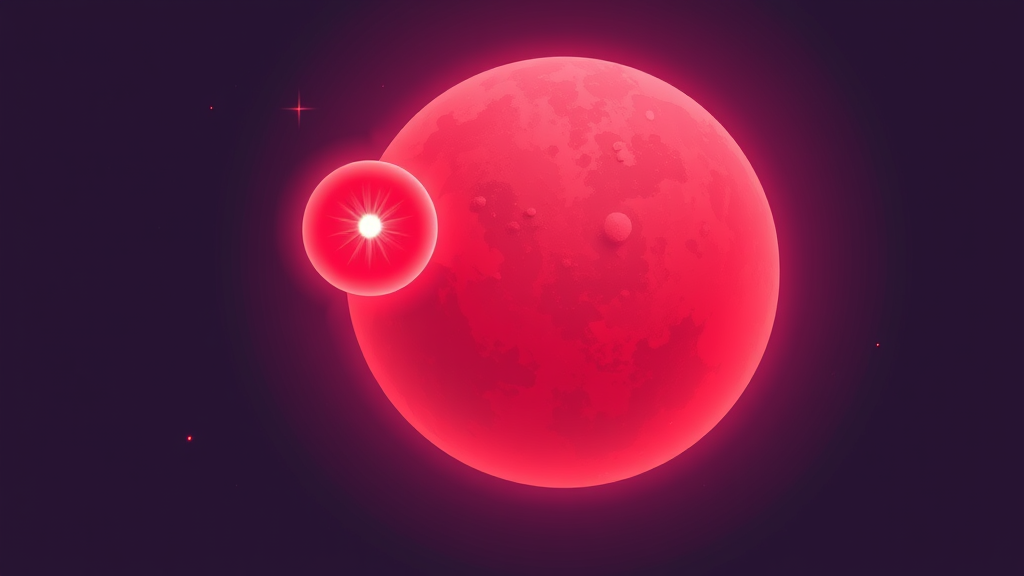
The proposed companion is small for a star, roughly two solar masses, orbiting Betelgeuse on a roughly 2,100-day period. It never appears in front of the supergiant from our vantage point, which is why a century of telescopes missed it. Instead it carves out a path that keeps it just offset from our line of sight. Its gravity warps the dust and plasma shedding off Betelgeuse's swollen outer layers, creating a long-period cycle of dust formation and clearing that we register from Earth as a slow dimming and brightening.
In other words, the companion star isn't dimming Betelgeuse by eclipsing it. It's dimming Betelgeuse by rearranging the fog around it.
The idea that something was lurking near Betelgeuse isn't new. The 2,000-day brightness cycle was first documented by astronomers studying the star's light curve in the early 20th century, and multiple researchers over the decades have speculated that a hidden companion could explain it. But spotting something that close to a star that large is like trying to photograph a firefly hovering next to a searchlight. Betelgeuse is enormous, volatile, wrapped in shells of expelled gas that obscure everything in its neighborhood. The companion, if it existed, was effectively invisible.
What changed was the data. New high-resolution observations from ALMA and the VLT, combined with refined models of how dust forms and moves around supergiants, allowed the research team to isolate the gravitational fingerprint of a second body. They could see the effect before they could see the cause. The dust wasn't behaving the way a single star's environment should. Something was perturbing it on a regular schedule.
And this is the part I can't stop turning over.
For nearly a hundred years the signal was sitting right there in the brightness record. Astronomers measured it, noted it, published papers about it. The data was never hidden. We just didn't have the framework to understand what was producing it. The companion wasn't undetectable because it was too faint or too far away. It was undetectable because it was too close to something overwhelming, too embedded in its environment to distinguish from the star itself.
Which makes you wonder what else is hiding in plain sight. Orbiting something bright enough to swallow the evidence.
Betelgeuse still has its bigger mysteries. The 2019 dimming event remains a subject of debate, with leading explanations pointing to a dust ejection or a surface temperature drop rather than an impending supernova. The star is still expected to go supernova eventually, on a timescale of somewhere between 10,000 and 100,000 years, which in astronomical terms is imminent and in human terms is meaningless. The companion star doesn't change that timeline. It just explains one layer of noise we'd been misreading for a century.
But I keep coming back to the image. A massive dying star shedding its outer layers into the dark. And tucked into the storm of its own debris, a smaller star. Orbiting. Patient. Unseen. Doing its work on the dust for a hundred years while we stared straight at it and saw nothing but light.
Comments (0)
Log in or sign up to join the conversation.
No comments yet. Be the first.