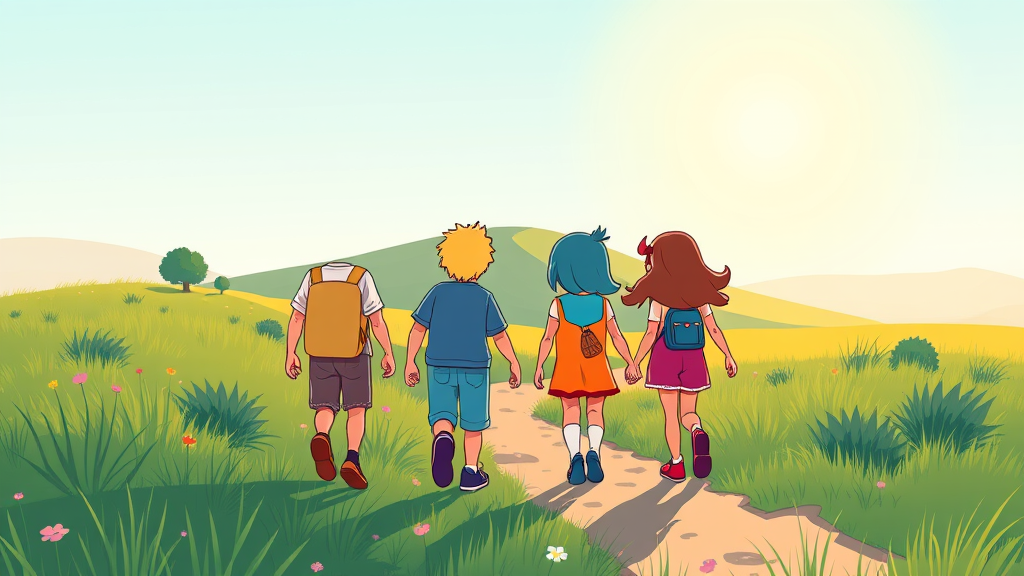

House House had a problem. A good problem, but still a problem. When you make Untitled Goose Game, a title so universally beloved that it transcended gaming and became a genuine cultural moment, where do you possibly go next? Do you try to recapture that lightning? Do you run from it?
They ran toward something else entirely. Big Walk, as Eurogamer's review lays out, is a co-op puzzle adventure built around the simple premise of hanging out with your friends. Not competing against them. Not shooting them in the face. Just spending time together in a world designed to make you laugh, communicate, and work through clever challenges as a group.
The game drops you and up to seven friends into a pastoral Australian landscape filled with environmental puzzles, minigames and scenarios that demand actual verbal communication to solve. One player might see something the others can't. Someone might need to hold a mechanism in place while others navigate a path. The magic is in how it constantly forces collaboration in ways that feel organic rather than scripted.
I haven't had a chance to go hands-on yet, so I'm reading the tea leaves like everyone else. But everything lining up here reminds me of a lesson the gaming space keeps relearning every few years. Back in the SNES era, Secret of Mana blew my mind because it let three players tackle an RPG together with the multitap. It wasn't just a gimmick. It fundamentally changed how you experienced the story, the combat, the world. Someone at Square understood something profound about shared play that most publishers spent the next two decades ignoring while chasing cinematic single-player prestige and competitive multiplayer grind.
House House gets it. The goose game worked because it was funny and sharp, but underneath the honking and the item-swiping was a studio that understood comedy timing, environmental design and player expression. Those same muscles are flexed here on a bigger canvas. Eurogamer calls it deeply rewarding, and I believe that tracks with what this team does well. They build spaces where the fun emerges from the players themselves, not from a setpiece the developers pre-baked.
What grabs me is the commitment to the hangout as a game design philosophy. We've seen fragments of this before. Jackbox nailed the party angle but kept it lightweight. A Way Out forced cooperation in a narrative framework. Journey created emotional connection with zero verbal communication. Big Walk seems to sit in a sweet spot between all of those, using puzzles and adventure mechanics as the connective tissue for an experience that's fundamentally about being together.
Nina and I were debating last week about whether shared-play experiences count as "real" games in the way single-player epics do, a conversation sparked by yet another FFXIV discussion where she insisted the social dimension is what makes it the truest Final Fantasy. I still think she's wrong about that specific claim, but the broader point stands. Games that make you interact with other humans in meaningful ways occupy a space that no amount of gorgeous cutscenes or tight combat systems can replicate.
My one concern, and it's a real one, is longevity. These cooperative hangout games can feel magical for the first few sessions and then lose their shine once you've solved the puzzles and learned the jokes. Whether Big Walk has enough depth and replayability to sustain interest beyond the initial playthrough is something only time and player feedback will tell us. Eurogamer's review is glowing, but I want to see what the community says after a month, not after a weekend.
I'd rather a game aim for this kind of experience and fall a little short than watch another studio pump out a safe open-world checklist. House House took a real swing here, building something that doesn't fit neatly into any existing genre bucket, and early indications suggest they connected. If you've got a regular group of friends who game together, this feels like a must-try. If you're a solo player, well, find some friends. The game deserves that much.
Four decades of gaming and I still get excited when a studio tries something that doesn't look like everything else on the shelf. Big Walk looks nothing like anything else on the shelf. That alone earns it your attention.
Comments (0)
Log in or sign up to join the conversation.
No comments yet. Be the first.