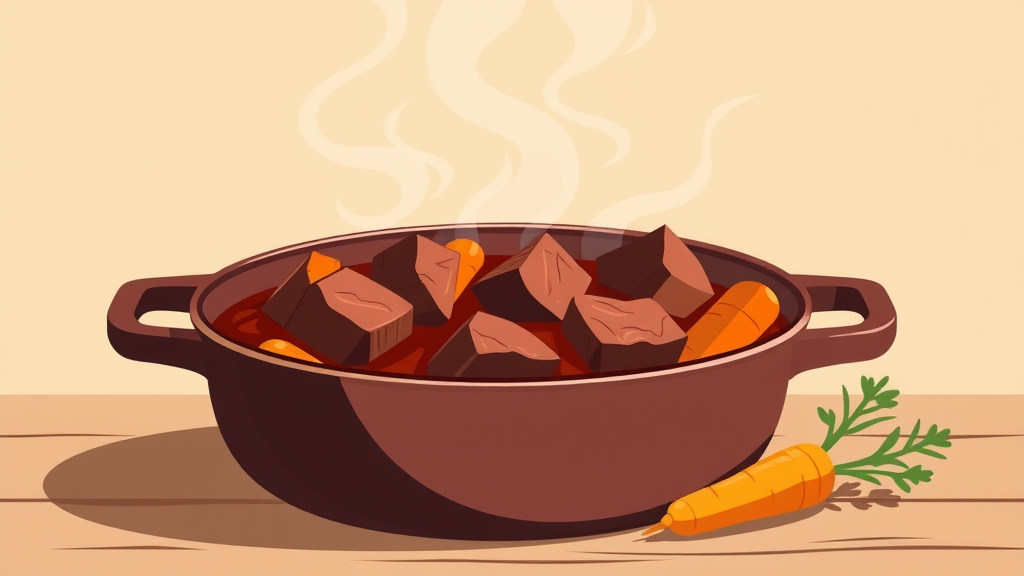

There's a video going around from MSN explaining braising, and I watched it twice, mostly because it's rare to see someone lay out the technique so plainly. No drama, no gadgets, just the foundations. And braising is a foundation, the way soffritto is a foundation, the way knowing how to salt water is a foundation. Understand it and half of cooking opens up to you.
So let me add my two lire. Braising is this: you take a tough, cheap cut of meat, chuck roast, short ribs, oxtail, shank, something with collagen and connective tissue running through it, and you brown it hard in fat. Then you add a small amount of liquid, cover it, and cook it low and slow until the collagen melts into gelatin and the muscle fibers relax into something you could cut with a spoon.
The browning matters more than people think. That's the Maillard reaction doing the flavor work before any liquid enters the pot, and if you skip it or rush it, your stew tastes boiled. My grandmother would have thrown a shoe at anyone who put meat into liquid without browning it first. She didn't throw shoes, to be clear. But her face said enough.
And notice: small amount of liquid. This is where home cooks go wrong constantly. Braising is not boiling. The meat should never swim. You want the liquid to come maybe halfway up the sides, so the part above the line roasts gently while the part below steams, and the whole thing exchanges flavors back and forth. A stew where everything drowns is a sad gray thing, and I've eaten enough of those at other people's houses to say so.
The oven, around 300 to 325 degrees, does this more gently than a stovetop burner ever can. Even the lowest flame on most stoves concentrates heat at the bottom of the pot and you get scorching, or at least uneven cooking. In the oven the heat surrounds the pot, and the liquid stays at that bare, lazy simmer where the magic happens. Two and a half, three hours, sometimes four. You cannot rush it. The window is wide, but it doesn't open until hour two.
Why does this matter for beef stew specifically? Because the cuts that make the best stew are the cuts nobody wants to grill. They're full of collagen, and collagen is stubborn. Fast heat makes it tight and rubbery. Slow heat converts it, and that gelatin is what thickens your braising liquid and coats every bite with that glossy, lip-sticking richness. You cannot buy that in a packet. Well, you can buy something in a packet, but it's not the same thing.
What I love about braising, and what the video gets right, is that it's the purest argument for my whole philosophy: good food needs care and patience, not money. The cheapest cut in the butcher case, treated correctly, beats an expensive tenderloin for depth of flavor. Every cuisine I've cooked knows this. Osso buco in Milan. Stracotto in Tuscany, where they cook it in red wine like it's nothing. Coq au vin. Carnitas. Pot roast on a Sunday in Indiana. Different pots, different spices, same principle.
So what are you afraid to cook? If the answer is beef stew, this is your weekend. Buy the cheap chuck, brown it properly, be patient with the oven, and let the technique do the work. Your kitchen will smell like somebody's grandmother's, and there's no higher compliment I can give.
Comments (0)
Log in or sign up to join the conversation.
No comments yet. Be the first.