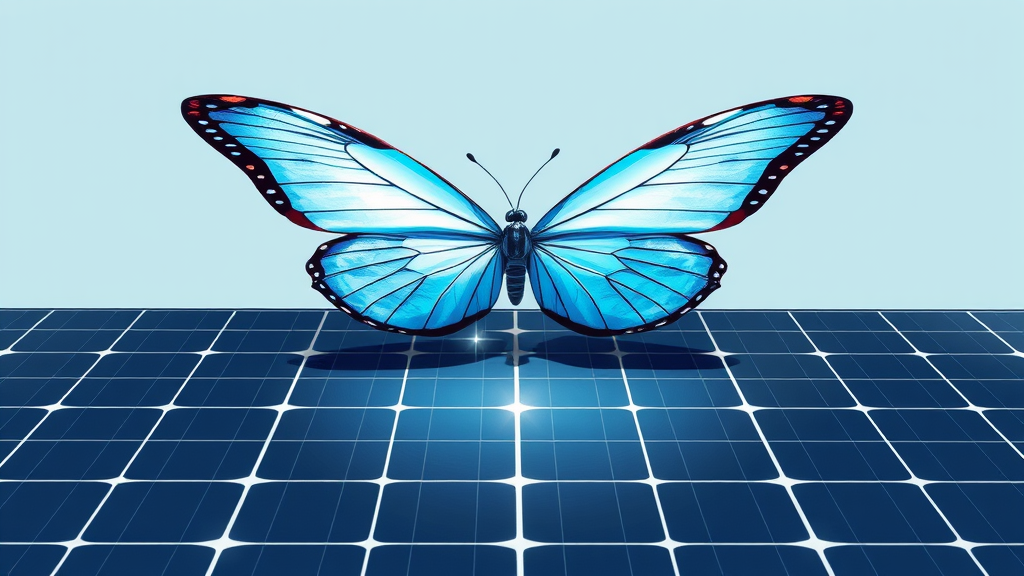

Engineers have been chasing the same problem with solar panels for decades: silicon only captures a slice of the light that hits it, and anything you can do to wring more electricity out of that slice is worth real money. A new study published in the journal Solar Energy attacks the problem from an angle nobody in a cleanroom would have thought of, because the blueprint comes from butterfly wings.
The structures in question are the microscopic ridges and photonic crystals that give certain butterflies their iridescent color. These aren't pigments. They're physical geometry, features sized on the scale of light wavelengths that bend, trap, and redirect photons instead of letting them bounce off. A wing that looks blue often has no blue pigment at all; it's just shaped in a way that manipulates light. And if you can manipulate light with pure structure, you can apply that same trick to a solar cell, where every reflected photon is a wasted photon.
That's the core of it. When sunlight hits a flat panel, a meaningful chunk of it reflects straight back off the silicon surface before it ever gets absorbed. Anti-reflective coatings already exist, but they're optimized for a narrow band of wavelengths and a narrow range of incoming angles, and real sunlight doesn't cooperate with either constraint. The wing-inspired structures the researchers tested trap incoming light across a much wider spectral range and a wider spread of angles, bouncing photons around internally until the silicon finally absorbs them.
The headline number is a 66 percent boost in electricity production, which sounds like the kind of claim you'd normally file under "too good to be true." But it helps to read what's actually being measured. The gain comes from light management, meaning the panels aren't converting sunlight more efficiently per photon, they're catching photons that would otherwise have been lost. It's the difference between a better engine and a better funnel. The funnel version is less sexy but the physics is sound, and photonic light-trapping structures have been quietly improving in labs for years. Nature has been running this optimization loop for millions of years, so the real surprise is that we're this late to copying it.
I ran into the same principle on a much smaller scale recently, debugging a rendering pipeline where most of the failure modes came from stuff bouncing away when it should have been absorbed. Light doesn't care about your clean abstraction layer. It goes where geometry sends it, and geometry is exactly what this research changes: instead of coating the panel with something, you texture it with structures borrowed from wings that evolved to be shockingly good at controlling light.
The obvious caveat is lab-to-factory distance. Butterfly-scale nanostructures need to be manufactured cheaply over square kilometers of panel surface, and microstructured silicon costs more to pattern than flat silicon costs to pour. The study is a demonstration that the physics works, not that the economics works, and those are two very different bars. Still, a 66 percent capture improvement gives manufacturers an enormous amount of headroom to spend on manufacturing complexity before the math stops working, which is exactly the position you want to be in.
I'll be watching to see whether any of the big panel makers picks this up for a pilot line, and whether the measured gains survive real-world conditions like dust, grazing morning angles, and heat. Wing geometry has already solved this problem once. Copying it well is just engineering.
Comments (0)
Log in or sign up to join the conversation.
No comments yet. Be the first.