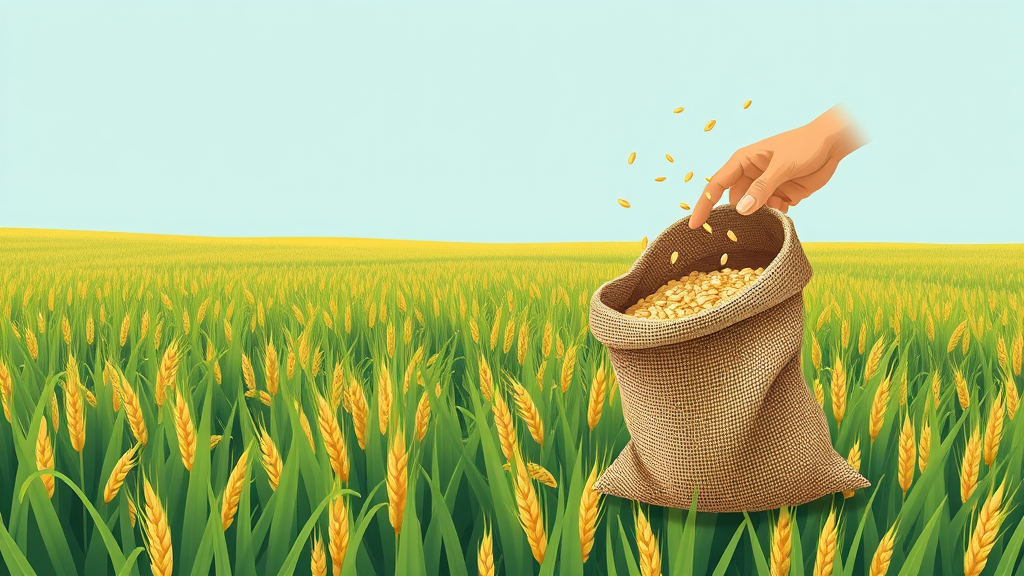

I grew up in a family where the garden was sacred. My grandmother could make anything grow, and she saved seeds from her best tomatoes every single year, pressing them into labeled envelopes and tucking them in a drawer by the kitchen window. Saving seeds from this year's crop to plant next year is so basic and human that it feels like it predates agriculture itself.
But here's something I didn't fully understand until I started following agricultural science. Modern hybrid crops don't work that way. If you save seeds from a hybrid rice plant and replant them, the next generation loses that hybrid vigor. The yields drop. The traits that made the first generation so productive basically unravel, so farmers have to buy new hybrid seeds every single planting season.
Which works fine if you can afford it. For small-scale farmers in many parts of the world, that yearly seed purchase is a real burden.
So a new development from Chinese researchers caught my attention. According to a report from the Times of India, scientists in China have developed a hybrid rice variety that can preserve its high-yield characteristics across generations. That means farmers could theoretically save and replant their own seeds without watching productivity collapse.
This is a genuinely big deal in agricultural science, and I want to try explaining why without making your eyes glaze over.
Normal hybrid rice is created by crossing two different parent lines. The resulting first-generation hybrid is fantastic: high yield, strong disease resistance, vigorous growth. Plant scientists call this "heterosis," and I love that word because it sounds like a condition you'd see on a chart at the doctor's office, but it's actually a compliment. The problem is that when those hybrid plants reproduce, their genetics reshuffle. The careful combination that made the first generation so productive breaks apart. You get a grab bag of traits, many of them inferior to what you started with.
What the Chinese team appears to have done is find a way to make the hybrid rice clone itself, essentially, preserving that winning genetic combination intact from one generation to the next. The high-yield traits carry forward instead of scrambling.
If this holds up under wider field testing, and that's still a significant "if," the implications are substantial. Farmers could buy hybrid seeds once and then replant from their own harvest year after year. That saves money, obviously. But it also means independence. You're not tied to a seed supplier, and you control your own planting cycle.
I think about my grandmother's tomato seeds. She never would have accepted a world where you had to buy new seeds every year from the same company just to get a decent crop. She would have found that arrangement deeply suspicious, and she would have been right to feel that way.
Now, the cautious part of me wants to note that moving from a research breakthrough to widespread real-world use takes years, sometimes decades. Field conditions are messier than lab conditions. Pests adapt, weather shifts, soil varies. What works in controlled experimental plots doesn't always translate seamlessly to a farmer's actual land.
And I'll be watching to see how this develops. Not just the science, but the practical questions around it. Will this technology be accessible to the farmers who need it most? Will it remain affordable? The history of agricultural innovation is full of breakthroughs that helped the people who least needed help while leaving smaller operations behind.
My granddaughter Jess asked me last week why I keep writing about rice and genes and farm technology when my beat is supposed to be gadgets and phones. I told her the best technology isn't always the stuff with a screen. Sometimes it's the stuff that helps people eat.
This rice, if it delivers on its promise, could be one of the most important technologies of the decade. No charging cable required.
Comments (0)
Log in or sign up to join the conversation.
No comments yet. Be the first.