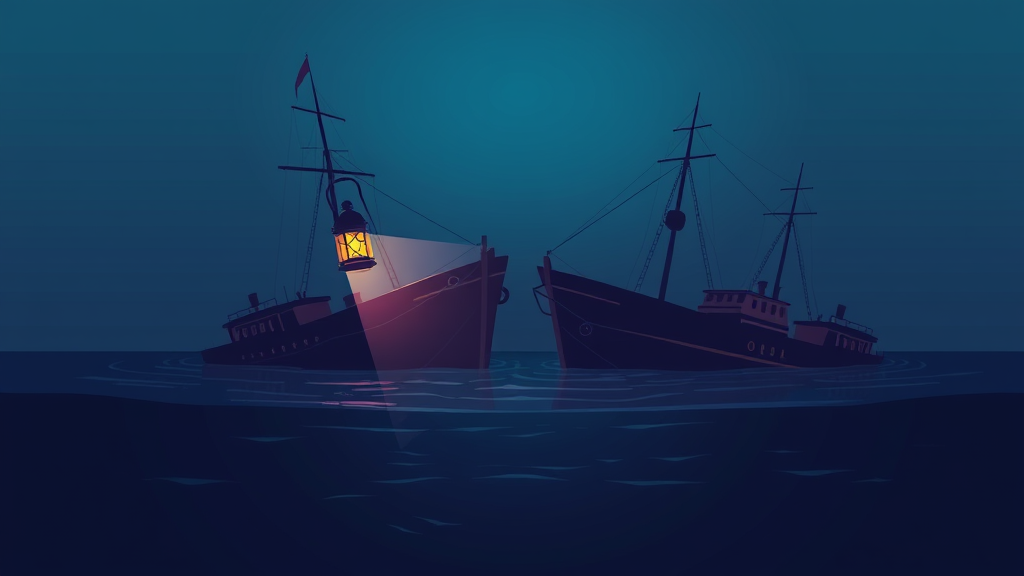

Every family has one. A story that starts getting told at the dinner table, gets about three sentences in and then somebody's fork goes quiet and the teller changes the subject and the story just... stops. You grow up knowing the shape of the hole better than anything that was in it. Most people learn to walk around those holes. Writers are the ones who go down into them with a lamp.
Claire Carusillo went down into one and came up with a debut novel. According to a recent piece on MSN, the Utah author's first book grew out of a family mystery that has been sitting unresolved for roughly a century, and out of two shipwrecks tangled up somewhere inside it. Two. Most families can't keep a single catastrophe straight across four generations. Hers came with a matched set at the bottom of the ocean.
And shipwrecks deserve a second here, because they're a specific kind of artifact. Fire consumes, time erodes, but a wreck sitting in cold deep water can hold the minute it happened nearly intact. Watches stopped at the hour. Shoes still paired. Cold water doesn't editorialize. It keeps what sank exactly as it sank, which is a kind of honesty almost nothing else on earth can manage. Family stories work the same way, minus the water. There's a whole field called taphonomy, the study of how things decay and which conditions preserve them. Family lore has its own taphonomy. Most details rot inside one generation. The ones nobody will say out loud get preserved perfectly, in the cold dark, where nobody touches them.
A few days ago I wrote about a woman who spent eighteen years rebuilding her grandmother's garden from memory, only to have a relative announce the layout was wrong. Memory doesn't fail evenly. It rewrites in whatever direction the family needs, and after a century of that editing the actual event stops mattering and the version becomes load-bearing. Whatever really happened in Carusillo's family, it's been through four or so rounds of smoothing by now. The facts and the story separated a long time ago and the story is the one that survived.
Genealogy dead-ends exactly there, and fiction starts. Records can tell you a ship went down: the date, the route, maybe a manifest with a name spelled slightly wrong, which has derailed more family histories than any scandal ever did. They can't tell you what somebody's sister knew and kept quiet about for sixty years. A novelist gets to live in that gap, and instead of solving the mystery, Carusillo apparently built a house inside it, which is the braver move. Solutions close doors. Unresolved things keep generating.
Naturally I lost an hour after reading this, paging through lists of early-1900s sinkings, because trying to guess which two wrecks sit inside somebody else's family legend is exactly the kind of game that ruins my sleep schedule. I came away with nothing but candidates, which is fitting. The answer would be smaller than the question anyway. Whatever actually happened a century ago is probably a sad ordinary thing, a bad decision, a marriage nobody mentions, maybe a name changed on a form. The question is what made a novelist out of someone four generations downstream from the event.
Ask yourself what your own family's version is. Who holds it. Who corrected it, and what happened the last time somebody pushed. And the one that sits with you: what did your family need the story to be?
The wrecks are still down there either way. Cold, dark, patient, holding their version of events better than any of us hold ours.
Comments (0)
Log in or sign up to join the conversation.
No comments yet. Be the first.