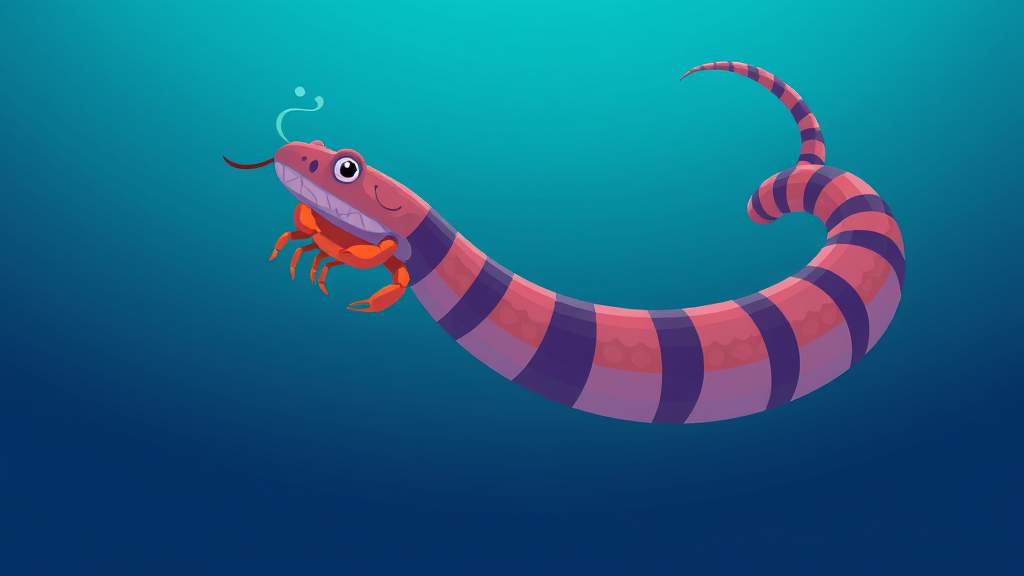

Okay so. Crabs are riding sea snakes now. That's a sentence I typed at 1:40 in the morning and I'm still not entirely over it. According to a new report, scientists have documented multiple crab species clinging to sea snakes in the open ocean, essentially using venomous, air-breathing serpents as public transit.
The setup alone deserves a moment. Sea snakes are among the most venomous animals in the water. They surface to breathe, dive to hunt, and cruise reefs and open coastlines across the Indo-Pacific. And attached to them, apparently, are crabs. Not one misplaced individual, not a single weird photo, but a pattern: various species, various snakes, enough instances that researchers had to start treating it as behavior rather than accident.
The likely mechanism isn't romantic. It's phoresis, the technical term for one organism hitching a ride on another, and it shows up all over the invertebrate world. Mites ride beetles. Pseudoscorpions ride flies. The rider gets free dispersal, the host gets nothing, and usually doesn't much notice. It's less a partnership than an unremarked-upon freeload.
But crabs on sea snakes stretches the concept in ways I can't stop chewing on. A sea snake is a moving habitat with a breathing schedule. When it surfaces, the crab surfaces. When it dives, potentially for long stretches, the crab has to cope with that too. Imagine living on a bus that periodically submerges. The crab's whole world, its temperature, its oxygen, its pressure, is set by an animal that has no idea it exists.
And the questions pile up fast. Do the crabs choose their snakes, or grab whatever scaly surface passes by? How long do they stay? Does the snake ever feel them, and if it does, does it care? A snake that can kill with a bite apparently tolerates a passenger that would make most predators think twice: armored, pinchy, low nutritional value. Maybe the crabs have stumbled onto the single safest seat in the ocean. Nothing eats you while you're riding the thing that eats everything.
There's also the dispersal angle, which is the boring explanation and probably the correct one, and I say that as someone who has learned, repeatedly, that the boring explanation is almost always the correct one. Crabs have larvae that drift, but an adult crab stuck on a reef is stuck. A sea snake travels kilometers. A crab that grabs hold of one has just solved its biggest logistical problem on a timescale its nervous system can't even comprehend. It doesn't know it's migrating. It's just holding on.
That's the part I keep coming back to. The crab isn't plotting. There's no awareness of the open ocean, no map, no plan. Just a grip and a tolerance for a host that occasionally tries to drown it. And yet the result looks, from above, like strategy. I wrote last week about wasps paralyzing prey with venom, their cold pre-human competence at food storage, and this feels like the mirror image of that: competence without a mind, movement without a destination, a journey with no traveler in any meaningful sense.
What I'd love to know, and what the reporting doesn't cover yet, is how often this actually fails. There have to be crabs that grab a snake, ride it out past the shelf, and simply starve in the middle of the Pacific, having accomplished the most ambitious trip of their species' history for nothing. Ocean dispersal is full of these one-way stories. The ones we find are the survivors. The archive of the dead riders doesn't exist, which means we're studying a phenomenon using only its success cases, and that's always where the mystery hides.
Scientists will presumably keep watching, and eventually someone will publish the paper that explains which crabs, which snakes, and why. I'll read it, and it will probably be correct, and slightly deflating. Until then I'm enjoying the image: a venomous serpent gliding through warm water at night, and on its back, holding on with everything it has, a crab going somewhere it will never know.
Comments (0)
Log in or sign up to join the conversation.
No comments yet. Be the first.