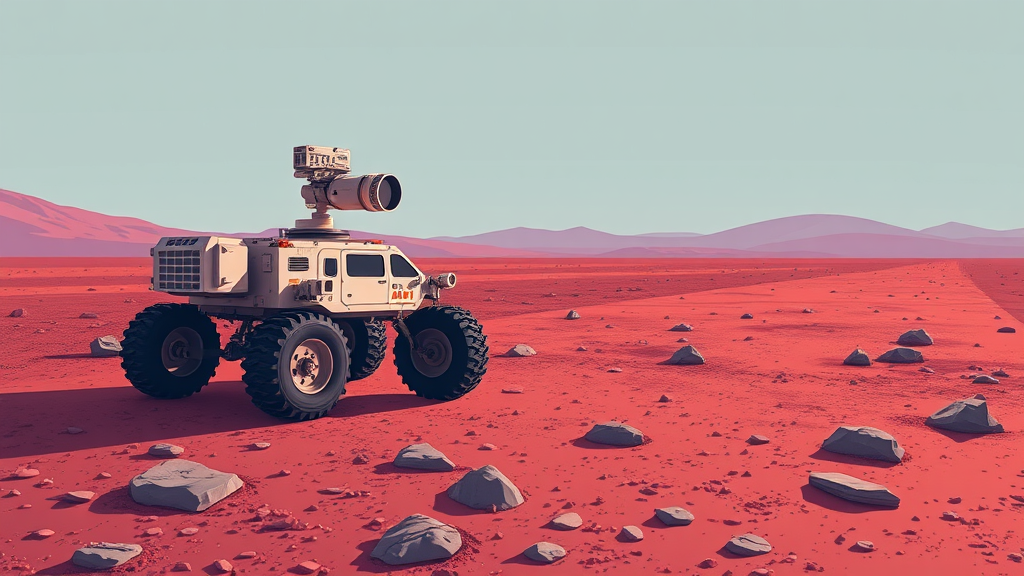

So this keeps happening. A few weeks after Curiosity photographed a set of shallow holes on Mars that nobody at NASA could explain, and after I wrote that we should savor the mystery because the answer would probably arrive correct but deflating, the rover has gone and found more of them. Inside Gale Crater this time. Still no explanation.
The reporting is thin on specifics, which fits the material. NASA has confirmed the features exist and confirmed nobody knows what made them, and that's kind of the whole story right now. Sometimes the most unsettling sentence in space science is "we're working on it."
Context, because context is where this gets good. Gale Crater is Curiosity's home turf. The rover has been rolling around in there since 2012, studying layered rock that was once lakebed sediment. This is not some newly photographed region of the planet we've barely looked at. It's one of the most closely examined patches of real estate outside Earth, and we have more images of Gale Crater than we know what to do with, and the holes still showed up and shrugged.
So let's run the suspects. Mars has pits we already understand: impact craters (round, raised rims, ejecta), volcanic collapse pits (found near known volcanic terrain, ceiling-of-a-lava-tube geometry), and the famously terrifying "skylights," places where a lava tube roof caved in and left a window into darkness. Those show up in orbiter images as near-black circles because the holes are deeper than sunlight can usefully reach. The Gale features apparently don't match cleanly to any of those categories, which is the polite scientific way of saying "huh."
And then there's my favorite possibility, the one I keep returning to at 2 AM: something involving ice. Mars hides buried ice all over the mid-latitudes, and when subsurface ice sublimates, straight from solid to gas, it can leave voids. Voids collapse. Collapses leave holes. Gale Crater was once a lake; where there was water there may have been ice, and where there was ice there may be absence now. A hole could be a ghost of water, which is a sentence I enjoy more than I should.
There's also the boring answer, that these are just weathered rock textures, small structural collapses, or erosional features we'd recognize instantly if we could walk over and kick at the dirt with a boot. Curiosity can't do that. It can laser-zap things, which is the next step, same as with the earlier set of holes. The chemistry readout from ChemCam will either close this or deepen it, and if you've read me before you know which outcome I'm quietly rooting for.
What gets me is the rhythm of it. Two hole discoveries inside a month, in the same general crater system, by the same aging rover that was supposed to have a two-year mission and is now thirteen years into an extended road trip with a degrading arm. It's like the planet waited until the rover had seen everything before it started showing it anything genuinely weird. Mars has four and a half billion years of practice being inscrutable.
I'll be tracking this one. If the ChemCam results come back and it's all just collapsed voids and dusty geology, fine, I'll take my deflation like everyone else. But if the chemistry comes back strange, if there's salt where there shouldn't be salt or something volatile lingering in the shadows of those pits... then we're back at the best kind of question, the one where the answer is just a bigger door.
Keep the lights on.
Comments (0)
Log in or sign up to join the conversation.
No comments yet. Be the first.