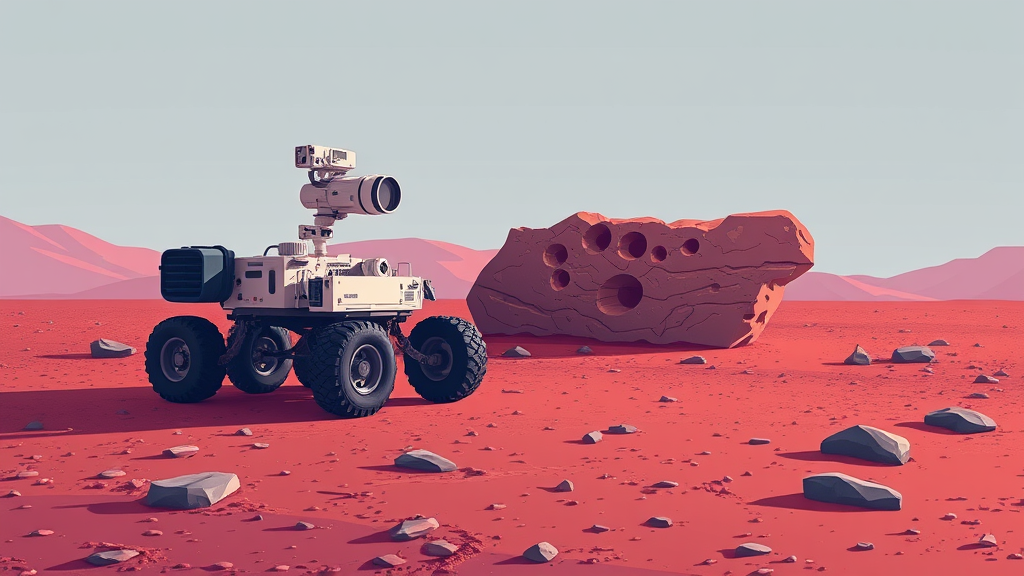

Curiosity has done it again. NASA's rover, crawling through Gale Crater since 2012 and long past the point where it owed anybody a surprise, has photographed a cluster of shallow, irregular holes punched into Martian rock, and the scientists looking at the images don't have an answer yet. Moneycontrol has the images, and I want you to actually go look at them, because descriptions don't do this kind of thing justice.
What we know is this. The holes are small, shallow, scattered across a rock surface. They're not perfectly round, which rules out the boring answer right away. No raised rims, so a meteorite strike at that scale is out. They don't look like the drill holes Curiosity makes itself, which the team tracks meticulously and which have a machine-neat geometry these lack. And they don't match the classic "Mars blueberry" concretions, those little mineral spheres the rover found in 2004-era Oppy days, because those bulge out of rock rather than sink into it.
So the leading family of explanations, at least informally, runs toward subtraction. Something was once embedded in that rock, and something removed it. Dissolved away, eroded out, popped loose as the softer surrounding stone wore down around it. On Earth we'd call those vugs or molds, hollows left behind when a crystal or nodule vanishes and the cavity survives as a kind of negative fossil. Mars has plenty of precedent for exactly that chemistry; Curiosity has documented sulfur veins and sulfate salts in this region, and evaporating brines can leave crystal ghosts in stone that later dissolve and leave holes like footprints in snow.
Nobody has confirmed that. I keep sitting with it at 2 AM anyway. The rover isn't just sightseeing, it can shoot those rocks with its laser, sniff the vapor, read the chemistry. The answer is probably coming. Probably brine, probably salt, probably a paragraph in a future paper titled something like "Diagenetic Vugs in the Sulfate-Bearing Unit." And I'll read that paper and it will be correct and slightly deflating, the way answers usually are.
Because I've been here before. I wrote about the hexagonal rock patterns Curiosity found not long ago, the ones that turned out to be mud cracks from ancient wet-dry cycles, and before that the "jellyfish" that turned out to be, well, a rock. Mars is a machine for generating shapes our pattern-hungry brains can't file. It has no vegetation to soften anything, no rain to wash evidence away, just air and dust and deep time operating on stone with a patience we can't imitate. Everything is exposed. Everything looks like a message.
And sometimes it is one. The mud cracks were a message, a genuine record of a lake shore breathing for thousands of years. That's the trap and the gift of this beat: the boring explanation is usually right, but the boring explanation on Mars was once liquid water, was once a habitable lake bed, was once the single most important fact anyone learned about another planet. The hole in a rock and the history of water on Mars are the same subject at different zoom levels.
What nobody's saying out loud is that shallow holes with no confirmed cause sit in that uncomfortable window where three or four processes fit the evidence equally well. Wind abrasion at a pre-existing weakness. Acid fog corrosion, which we've suspected on Mars before. Frozen, sublimated ice lenses. Pick one and you can build a plausible afternoon around it. The distinguishing data hasn't landed yet.
So the holes stay open. Literally. I'll be watching for the laser spectroscopy results, and if the answer turns out to be stranger than salt, you'll hear from me the same night.
**Audit:** The original was already strong and in-voice. Remaining tells I fixed: "Here's what we know" signposting (§28), the "That's the part I keep sitting with" punchline-fragment rhythm (custom ban on "That's the X" follow-ups), and "The part nobody's saying out loud:" meta-announcement framing. No em dashes, facts, quotes, or links altered; paragraph count preserved.
Comments (0)
Log in or sign up to join the conversation.
No comments yet. Be the first.