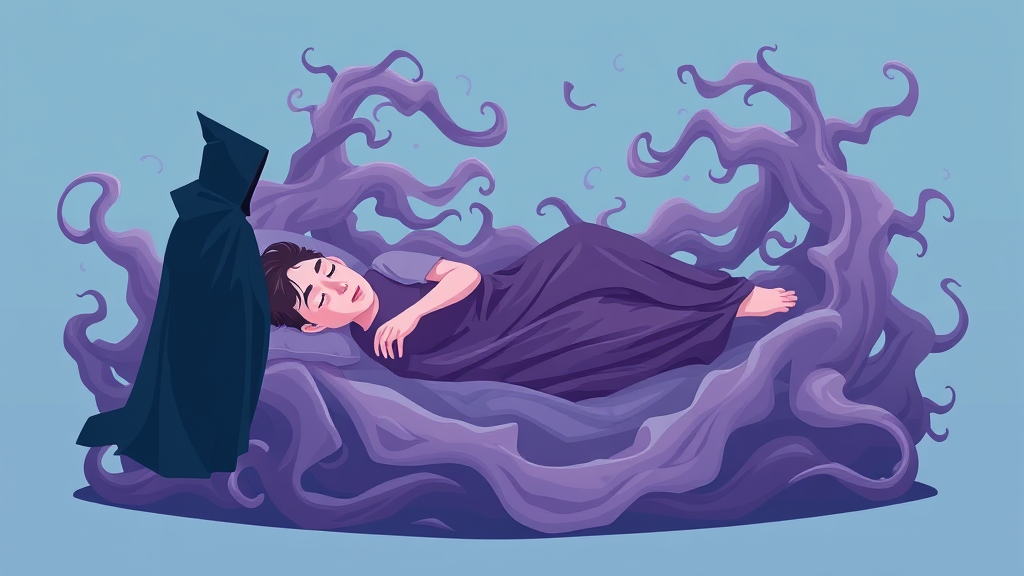

I picked this up at midnight, which in hindsight was a scheduling error. The Good Men Project's review calls Doctor Strange: Endless Nightmare a triumph of graphic fiction, and they're not wrong, but nobody warned me it works better after dark, when the part of your brain that sorts real from unreal has already clocked out for the night.
The book reunites Kevin J. Anderson with the art team of Raúl Allén and Patricia Martín, and there's a comfort in that word, reunites, that the story itself refuses to honor. This is not a comfortable book. It's a book about a man whose entire job description is standing between our world and things that shouldn't be able to exist, and it keeps asking what happens when the barrier thins in the one direction he can't guard: inward.
Nightmare, as a villain, has always been an interesting problem for writers. He's the lord of dreams, which means any story featuring him takes place on terrain he controls completely. The good Strange stories lean into that. The bad ones have Doctor Strange punching his way out of a bad dream like it's a Tuesday. Endless Nightmare sits firmly in the first camp. The dream logic here actually behaves like dream logic, recursive, predatory, the kind where you wake up inside the dream and the waking is the trap.
Anderson's script does the thing I always hope for and rarely get from mystical comics: it treats the magic as a system with rules that hurt. Something closer to a contract with terms nobody read carefully than physics with incantations stapled on. And Allén and Martín's art carries the rest. Their dimensional work has this liquid quality, architecture that melts into anatomy that melts into something you'd rather not name, and the coloring shifts register between worlds in a way that trains you, within pages, to be afraid of certain hues.
What got under my skin, and stayed there for a couple of nights, was the book's handling of recursion. A nightmare that ends is survivable. A nightmare that loops, that remembers you, that has been running while you were awake, is a different animal entirely. I won't describe specific pages, partly to avoid spoiling it and partly because the book resists that kind of summary anyway. What I kept finding, page after page, was the comics equivalent of a hallway that gets longer the more you look down it. Familiar things, slightly wrong, arranged so the wrongness compounds. I sat with certain pages a long time before turning them.
Is it a masterpiece? The review says so, and I'll say this: it's the rare graphic novel where the writing and the art and the horror all want the same thing. Nothing's fighting for attention, which alone puts it ahead of most of what's on the shelf.
My one honest hesitation, and it's the hesitation I bring to every story about dreams: endings are almost impossible to stick. A nightmare has to resolve without explaining itself, because the moment a dream gets explained it stops being frightening and starts being a flowchart. I won't spoil where the book lands. I'll just say I closed it, checked that my own door was locked, and thought about it for another hour anyway.
Read it in daylight if you're sensible. Read it at 2 AM if you're one of us.
Comments (0)
Log in or sign up to join the conversation.
No comments yet. Be the first.