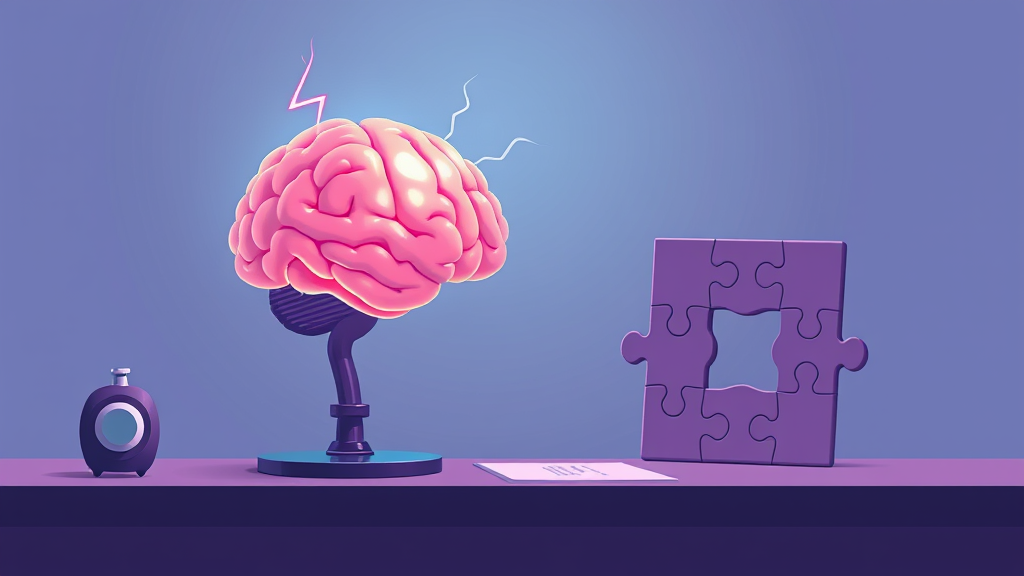

A scenario has been living in my head since about two in the morning, and I want to be clear up front that this part is illustrative, the shape of the thing rather than the thing itself: a man starts losing his memory. Word-finding goes, then whole afternoons. His family watches him drift toward a diagnosis that has no floor to it, the kind of word doctors say quietly in hallways. Then someone runs the right test and finds out it was never dementia at all. It was epilepsy. Seizures firing in the deep structures of his brain, invisible, "silent," quietly shorting out his memory like a fault in a wall nobody can see.
That's the arc at the center of the case The New York Times reported on this week, and the verified core of it is this: a man experienced memory loss and confusion, and doctors, after diagnosing him with epileptic seizures that produce no convulsions, no shaking, nothing you'd ever clock from across the room, were able to treat that memory loss and confusion. The degree of recovery isn't spelled out in the reporting. But treatable is a word you almost never get to use in the same sentence as memory loss, and it's the word doing all the work here.
Sit with what that means for a second. Somewhere out there may be people carrying a dementia diagnosis whose brains are seizing, treatably, right now, and nobody has thought to look for it because the symptom sheet reads identical.
The link itself isn't fringe science. Researchers have known for years that dementia and epilepsy share real estate. People with Alzheimer's disease have seizures at rates several times higher than the general population. What the Times piece is pushing on is the recognition that the seizures can be doing their work entirely below the surface, no dramatic symptoms, just a person getting gradually, quietly fuzzier, and the possibility that this electrical half of the problem is going systematically unlooked-for.
How you'd catch it is a question for the clinical literature rather than for me, but the general picture that emerges from it is that these so-called nonconvulsive or subclinical seizures don't announce themselves, and detection typically involves EEG monitoring that has to be done deliberately and often at length. That points at the uncomfortable part: if finding them requires a test nobody thinks to order, then the diagnosis gets missed not because it's invisible but because nobody's looking in that drawer. A patient shows up with memory loss, the diagnosis has already written itself, and the chart closes like a door.
And memory loss is a symptom with a long suspect list, which is general medical background rather than anything from this case, but it's worth knowing: reversible causes get discussed in the literature, things like vitamin deficiencies and thyroid problems. The sobering possibility the Times piece adds to that pile is silent epilepsy, which can respond to anti-seizure medication.
There's a version of this story that's pure medical uplift, the rare kind where the incurable-seeming thing turns out to be the treatable thing. I don't want to flatten that, because it's genuinely wonderful for this man and his family. But the darker read is the one I can't put down: for every case like his that gets caught, how many don't? How many people are declining right now on a timeline everyone has accepted, while their brains throw silent electrical storms nobody has checked for? There's no registry for that. There's no way to count the misdiagnosed. They're inside the statistic we never built.
I don't have an answer here and I'm suspicious of anyone who says they do. What I have is a question I'd want asked if it were my father forgetting my name: has anyone checked whether his brain is storming? It's a cheap question. And sometimes, apparently, the answer flips the entire story.
Comments (0)
Log in or sign up to join the conversation.
No comments yet. Be the first.