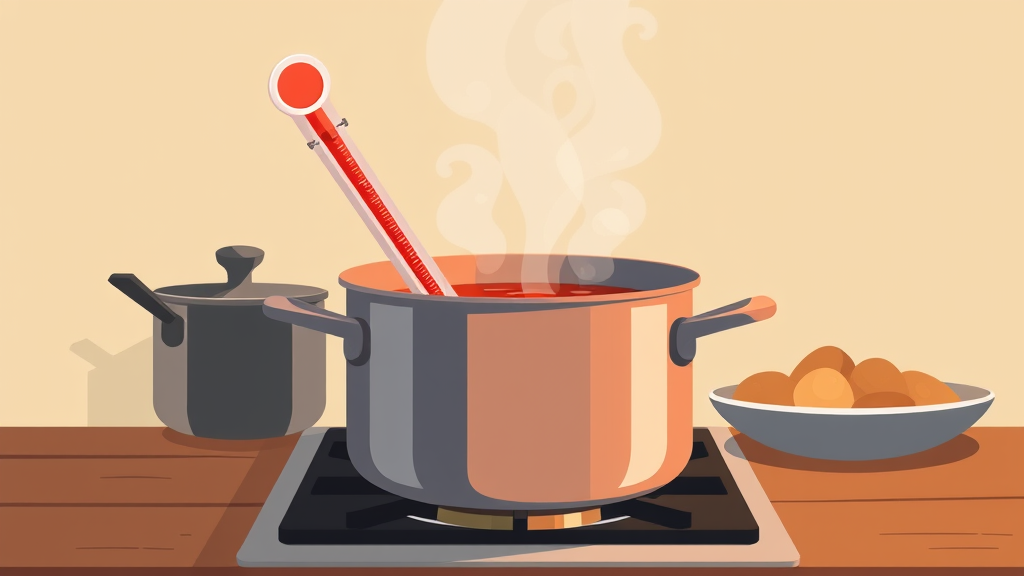

The least glamorous subject in food writing is the temperature log. Last month, health inspectors in Middletown cited eleven establishments for serious violations, and according to the report, most of them came down to the same basic failure. Food was sitting at the wrong temperature. Nine restaurants, a soup kitchen, and a food truck, all tripping over the same invisible thing.
Invisible is the right word. Nobody tastes a danger zone. A pot of ragu held at 55 degrees looks exactly like a pot held at 165. It smells the same, it tastes the same, and this is precisely why temperature is where kitchens get lazy. In my grandmother's kitchen outside Naples, there was no thermometer, but there was a woman who had fed a family through a war and understood, in her bones, that the pot on the back burner was not the pot on the front. She'd rap your knuckles for less.
The rule itself is simple enough that a twelve-year-old can learn it, and in every kitchen I worked in, from Rome to Bologna to Florence, somebody's twelve-year-old cousin had. Cold food stays cold, below 41 degrees. Hot food stays hot, above 135. The territory between the two is where bacteria throw their festival, and the longer food lives there, the more guests arrive. A health inspector with a probe thermometer is not looking for dirt on the floor. He is looking for time spent in that territory.
The list of cited places matters less than the pattern, but the range tells you something. Restaurants, yes, but also a soup kitchen and a food truck. I want to dwell on that for a second, because it dismantles a comfortable myth, that violations are a problem of bad restaurants. A soup kitchen is often working with donated food, volunteer staff, improvised equipment, and enormous goodwill. A food truck has a tiny compressor fighting a losing battle against a July sun. Neither is careless by nature. Both are operating at the edge of what their equipment allows, and July in particular is merciless. Hot months are when temperature discipline gets tested hardest, and when the citations stack up.
What does a "serious" violation actually mean? Generally it's a critical item, the kind linked directly to foodborne illness: improper holding temperatures, inadequate handwashing, cross-contamination between raw and ready-to-eat food, food from unapproved sources. Serious does not mean the place is filthy, and it does not mean the food made anyone sick. It means the conditions were present that could make someone sick, and the inspector caught it. Most establishments correct critical items on the spot or within days, and a citation in July is often a clean sheet by September.
Still. I take no pleasure in any of this, and I'd ask you not to either. The instinct when these lists publish is to treat them like a scarlet letter, to screenshot and shame. I've spent enough time in kitchens to know that the difference between a cited kitchen and a celebrated one is sometimes one shift, one broken cooler, one cook who got slammed on a Friday and let the steam table drift. Care is a practice, not a permanent state, and it fails in moments rather than in character.
And the practice is learnable. Buy a probe thermometer, the instant-read kind, the cost of two coffees. Use it. Calibrate it in a glass of ice water until it reads 32 degrees. If you run any kitchen, professional or otherwise, that single habit prevents more illness than any amount of scrubbing ever will. Temperature is the one food safety rule you cannot eyeball, and the one that catches almost everybody eventually.
As for Middletown, I hope every one of those eleven places fixes the drift and stays open. A soup kitchen feeding people does holy work, and it deserves a walk-in cooler that works, not a public shaming. Good food needs care, not money, but care has to include a thermometer. My grandmother had her knuckle-rapping instincts. The rest of us should probably just buy the tool.
Comments (0)
Log in or sign up to join the conversation.
No comments yet. Be the first.