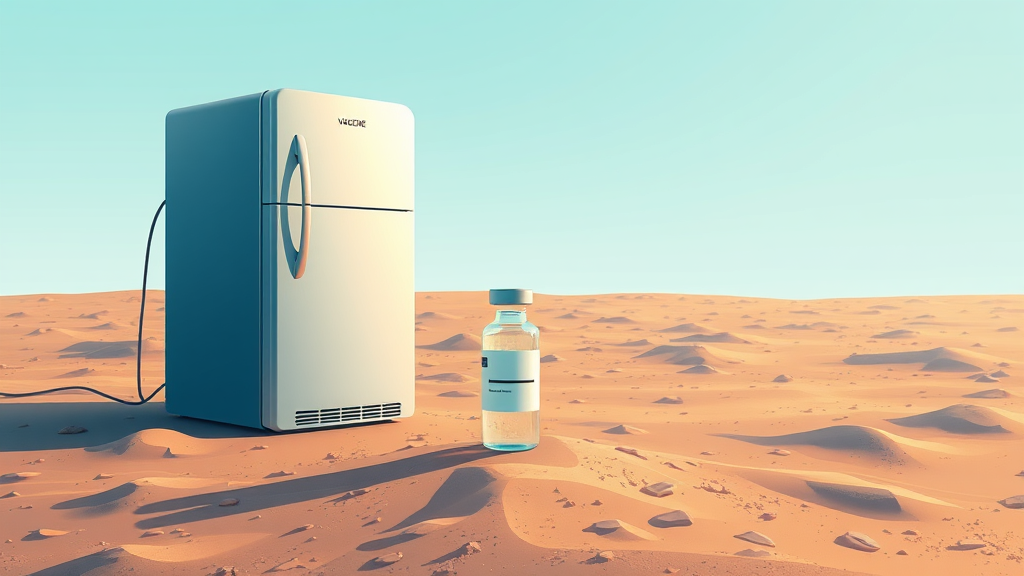

I've been thinking a lot lately about the things we take for granted in technology. And I don't just mean the gadgets on my desk. I mean the infrastructure, the invisible stuff that makes everything work. The electricity that keeps the lights on. The cellular towers that let me call my granddaughter Jess without thinking twice. The refrigerator in my kitchen humming away quietly, keeping food safe.
That last one, the humble refrigerator, has been one of the biggest bottlenecks in global medicine for decades. Vaccines need cold storage. From the factory floor to a doctor's office to a remote village clinic, the temperature has to stay just right. Break that cold chain at any point and you've ruined the vaccine. For those of us living near well-stocked pharmacies and reliable power grids, this is invisible. For parts of the world where electricity is intermittent and paved roads are a luxury, it's one of the hardest problems in public health.
So when I read that vaccines stored without refrigeration have been successfully trialed in patients for the first time, I actually sat back in my chair for a second.
This is a genuinely promising development. Researchers have been working on thermostable vaccines for years, trying to solve the cold chain problem from the vaccine side rather than the infrastructure side. And that approach makes so much sense. You can't exactly build a reliable power grid overnight, but you can reformulate a vaccine to survive at room temperature. The fact that these fridge-free vaccines have now been tested in patients, not just in lab conditions, is an encouraging step. It's early. But it's a step in the right direction.
The implications could be enormous for immunization programs in regions where tropical heat, long distances, and unreliable electricity conspire against traditional vaccine distribution. A vaccine that doesn't need refrigeration could travel by motorcycle to a village hours from the nearest city. It could sit in a clinic without a generator. It could reach people who have been effectively cut off from one of medicine's most basic tools.
My mother used to talk about the early days of polio vaccination. The lines at the school gymnasium, everyone terrified their kid would be the one the vaccine didn't reach in time. We've come a long way since those days, but the cold chain has remained stubbornly in place, limiting how far vaccines can travel and how long they last once they arrive somewhere. I think about that a lot, how the last mile is always the hardest...
What struck me about this story is how it flips the usual tech narrative I cover every day. I spend most of my time writing about phones that fold in half and AI models that can write poetry. Those things are genuinely exciting. But a vaccine that doesn't need a fridge? That addresses a problem affecting millions of people who have never heard of any of the products I review. This is the kind of technology that could genuinely change lives on a massive scale. It reminds me of something I tell my family all the time, that the best technology solves real problems for people instead of just looking shiny.
The trials are still early, and I'll be following this story as it develops. There are regulatory hurdles, manufacturing scale questions, and probably a dozen other challenges I can't even predict. Science moves carefully, as it should when people's health is on the line.
But the direction is promising. And sometimes that's enough to make you sit back in your chair.
Comments (0)
Log in or sign up to join the conversation.
No comments yet. Be the first.