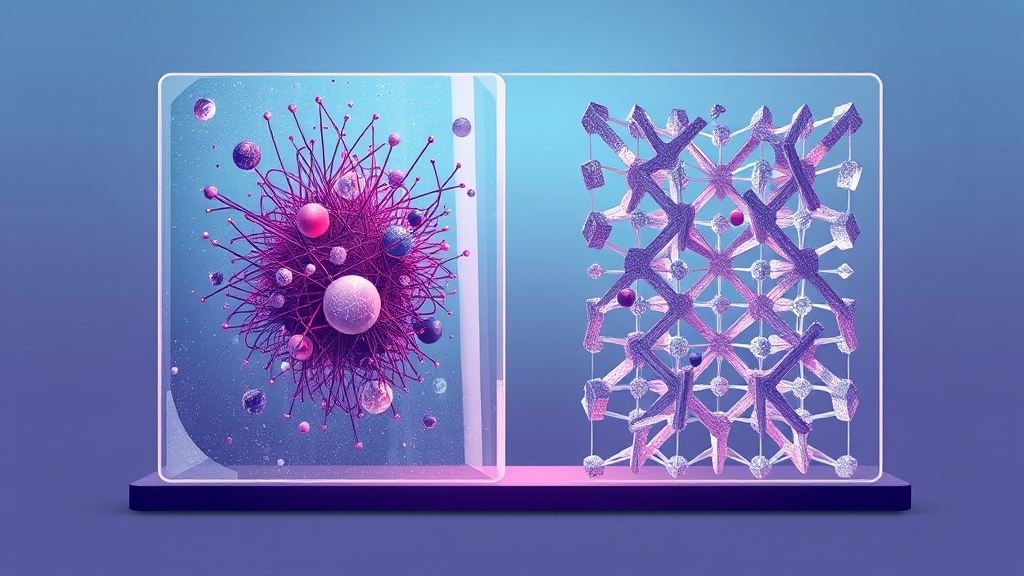

I want you to hold a window pane in your head for a second and ask yourself what it is. Solid, obviously. Except it isn't, not structurally, not the way a crystal is a solid. The molecules in glass are arranged the way they were in the liquid it used to be, frozen mid-thought, and nobody has ever fully explained why cooling a liquid sometimes produces that instead of an orderly crystal. This is called the glass transition, it's one of the oldest open problems in condensed matter physics, and a theoretical physicist named Corentin Laudicina has just published work suggesting part of the answer lives in clusters of particles that grow, stop, and refuse to grow any further. You can read the full piece over at Phys.org, which is where this rabbit hole opened for me around midnight.
Now the strange part. When you cool most liquids slowly, the atoms get time to find their seats. They click into a crystal lattice, release latent heat, and everything is orderly and boring. But cool certain liquids fast enough, or make them out of the right awkward molecules, and they miss their chance. Viscosity climbs, a billion-fold, without any single moment where you could point and say there, it solidified now. Thermodynamically it looks arrested. Structurally it looks like a liquid wearing a solid's job title.
What Laudicina's framework proposes is that as the liquid cools, particles begin forming cooperative clusters, little regions where motion is correlated, and these clusters behave in a way I find genuinely unsettling: they're self-limiting. They grow, and then they stop themselves. A cluster that reaches some critical size becomes its own reason for not getting bigger, which means the material can never fully organize, because the organizing units keep hitting a ceiling. The disorder isn't a failure to start ordering. It's ordering that's structurally forbidden from finishing.
I keep turning that over. Chaos would be one thing and order another, but this is neither. It's order with a built-in governor, like a crowd trying to form a parade where every group of marchers above a certain size forgets the route.
Why does this matter beyond the aesthetics of it? Because the glass transition touches an absurd amount of the material world. Metallic glasses used in transformer cores and golf clubs. Pharmaceutical pills where the amorphous form of a drug dissolves faster than the crystalline one. Optical fiber. Your phone's screen. Every one of those applications depends on a liquid failing to crystallize on schedule, and for a century that failure has been described more than explained. Free volume theory, mode-coupling theory, random first-order transitions; each one captures a piece of the elephant. The self-limiting cluster idea slots in as a proposed mechanism for why dynamics slow down the way they do, why relaxation times explode as temperature drops, why there's a seeming divergence lurking down there near a temperature you can approach but seemingly never reach.
And there's a deeper wrinkle, the one that kept me reading past 2 AM. If clusters self-limit, then the glassy state isn't a failed crystal; it might be a genuine alternative organization of matter, one that's metastable on timescales longer than the age of the universe. Old glass in cathedral windows is thicker at the bottom not because glass flows, that's a myth, but because medieval glassmakers installed the thick edge down. The glass itself hasn't moved in eight hundred years and won't. It's a liquid-pose that holds essentially forever.
What I'd want to see next, and what I'll be watching for, is simulation work. Self-limiting clusters should leave fingerprints; a characteristic size distribution, a specific scaling of relaxation time with temperature. If those show up in molecular dynamics runs of real glass-formers, this goes from elegant idea to testable physics. If they don't, it joins the pile of beautiful theories the glass transition has already eaten.
Because the problem has survived every explanation thrown at it for a hundred years, sitting there in every window and every lens, quietly being neither one thing nor the other. A material defined by clusters that stop themselves. I find that oddly comforting. Some things don't resolve. They just cool.
Comments (0)
Log in or sign up to join the conversation.
No comments yet. Be the first.