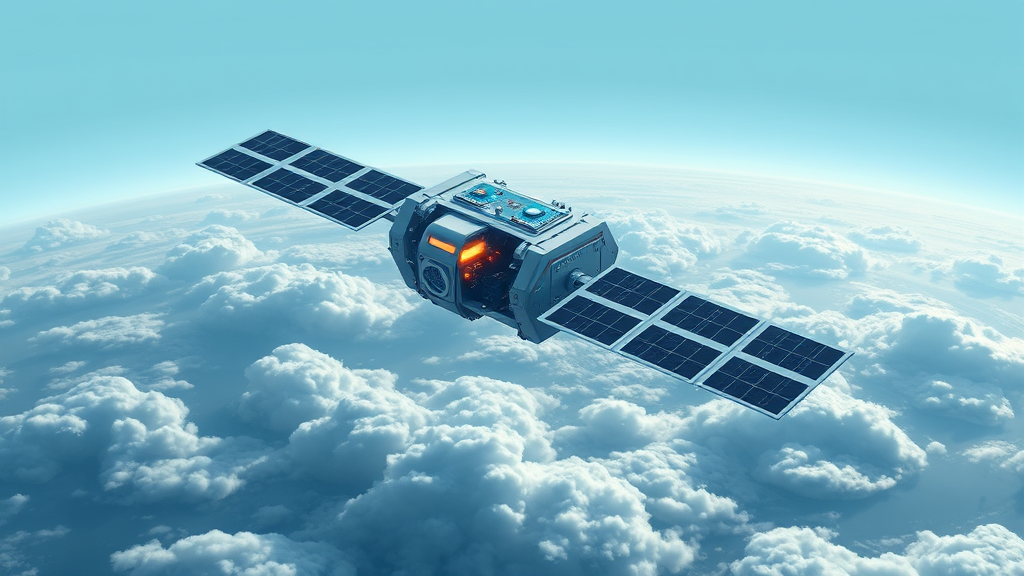

Well, here's one way to solve the data center problem. Reuters reports that Google plans to launch a prototype satellite next week, and it's the first in-orbit test of something called Project Suncatcher, a research effort to figure out whether large-scale AI computing could eventually run in space.
Sit with that for a second. These aren't communications satellites or earth imaging ones. These are actual AI chips, floating up there, doing the kind of number-crunching that currently happens in enormous buildings on the ground. Buildings that drink power and water and take years to build.
I've watched a lot of ambitious tech ideas come and go since 1984, and I've learned the wild-sounding ones sometimes turn out to be the important ones. Nobody thought regular people needed a computer in their home back then. Nobody thought a phone needed internet. So when Google says it wants to test whether space can host computing infrastructure, I don't laugh. I take notes.
The logic is actually pretty sensible once you think it through. AI computing is hungry, mostly for electricity and for cooling. Ground-based data centers are expensive, slow to build, and increasingly unpopular in the neighborhoods around them. Space offers free sunshine around the clock if you pick the right orbit, and cooling, well, radiators work differently up there but the thermal problem looks different too. If the physics and the economics line up, you could theoretically build computing capacity faster than you can on Earth.
The word doing a lot of work in that paragraph is "theoretically." This first launch is a prototype. It exists to answer basic questions, like whether the chips survive the ride, whether radiation mangles them over time, and whether servicing and maintaining hardware in orbit is anything close to practical. Nobody at Google is claiming we'll all be streaming answers from an orbital server farm next year.
What makes this interesting to me is the gap between the size of the ambition and the smallness of the first step. That's usually how these things go. The first iPhone had no App Store and couldn't copy and paste. The first test here is presumably a small stack of hardware on a single satellite. But if it works, it's a proof of concept for something much bigger.
There's a familiar competition angle too. Tech companies have been scrambling for AI computing capacity for years now, and the constraint isn't going away. My colleague Marcus could explain the actual chip architecture far better than I can, but the short version is this: whoever figures out cheap, scalable compute for AI has an enormous advantage, and the usual playbook of buying land and building data centers is hitting real limits. Looking up is the logical next move, even if it sounds like science fiction.
Should you care about this as a regular person with a phone and a router? I'd say yes, quietly. If space-based computing works, the AI tools you use could get cheaper and faster to scale, and the strain on local power grids and water supplies could ease. It's one of those developments whose effects would reach you long after the news cycle moves on. The tech that actually works for you tends to arrive that way, quietly and without a parade.
I'll be watching the launch next week and will report back on how the test goes, assuming Google shares results. Space has a way of humbling even the best-engineered plans, and I've been around long enough to know the first try rarely tells the whole story. But the first try is how every revolution I've ever covered got started...
Comments (0)
Log in or sign up to join the conversation.
No comments yet. Be the first.