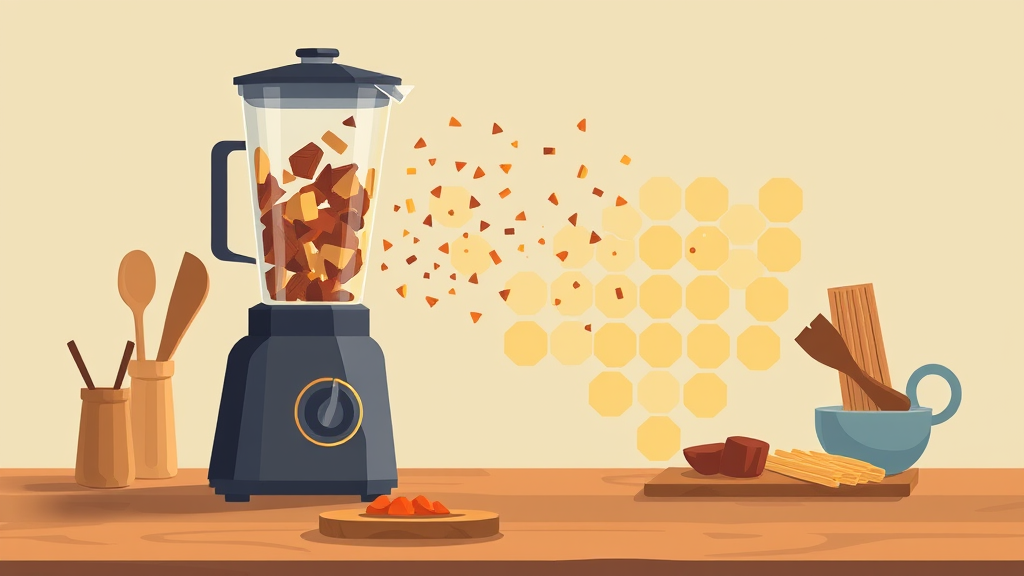

A story crossed my desk this week that has nothing to do with restaurants, and I cannot stop thinking about it anyway. Scientists have shown that graphene, the famous wonder material, can be produced with a kitchen blender, a mobile phone, and a newspaper. You can read the full piece here, and I recommend you do, because it is stranger than it sounds.
First, for those of us who spent our lives worrying about ragu instead of materials science: graphene is a single layer of carbon atoms, arranged in a honeycomb pattern, one atom thick. It is absurdly strong, it conducts electricity beautifully, and for two decades we have been promised it would change everything. Better batteries, better phones, better everything. The problem was always that making it cleanly required serious laboratory equipment and serious money.
And now, apparently, a blender.
You can imagine why this stopped me. I grew up in a kitchen outside Naples where the tools were a wooden spoon, a battered aluminum pot, and two hands that had made the same dishes ten thousand times. My grandmother would have understood this story in one second. That extraordinary results can come from ordinary equipment is not a surprise to anyone who has cooked for a living. It is the entire profession.
And the comparison is not decorative, either. What the blender does to graphite is basically what a food processor does to pesto: brute force applied with enough patience that the material separates into its smallest useful pieces. The scientists suspend graphite in liquid and let the shear forces peel off layer after layer until you have graphene flakes floating in what looks like dirty water. No furnace. No clean room. Just agitation, time, and a liquid medium. Any cook who has ever whisked a vinaigrette into glossy suspension knows this principle in the wrist.
The mobile phone and newspaper parts are, from what the reporting describes, about the humble mechanics of the setup, the kind of improvised rig that would make my grandmother nod and a venture capitalist faint. This is how real discovery often looks. Not spotless and chrome, but duct tape and improvisation.
I write about food, so why am I telling you this? Because the philosophy transfers completely. I have believed for years, and written in this column more than once, that good food needs care, not money. The same is apparently true of advanced materials. The expensive laboratory and the three-star tasting menu both have their place, but the breakthrough and the perfect plate so often come from someone paying close attention with the tools already in the house. The cook who masters a cast iron pan before buying the copper one. The researcher who reaches for the blender.
There are limits, and I should be honest about them. Blender-made graphene is not going into next year's smartphones; scaling up quality and consistency is the hard part, the same way your home oven will never bake two identical loaves of bread in a row. The lab version remains superior for demanding applications. But that was true of every technique that eventually became standard, and the door this opens for schools, small labs, and curious people with a spare blender is worth more than any single batch of flakes.
My grandmother used to say that the recipe doesn't matter, the attention does. I always thought that was just kitchen wisdom. It turns out it might be physics too.
Comments (0)
Log in or sign up to join the conversation.
No comments yet. Be the first.