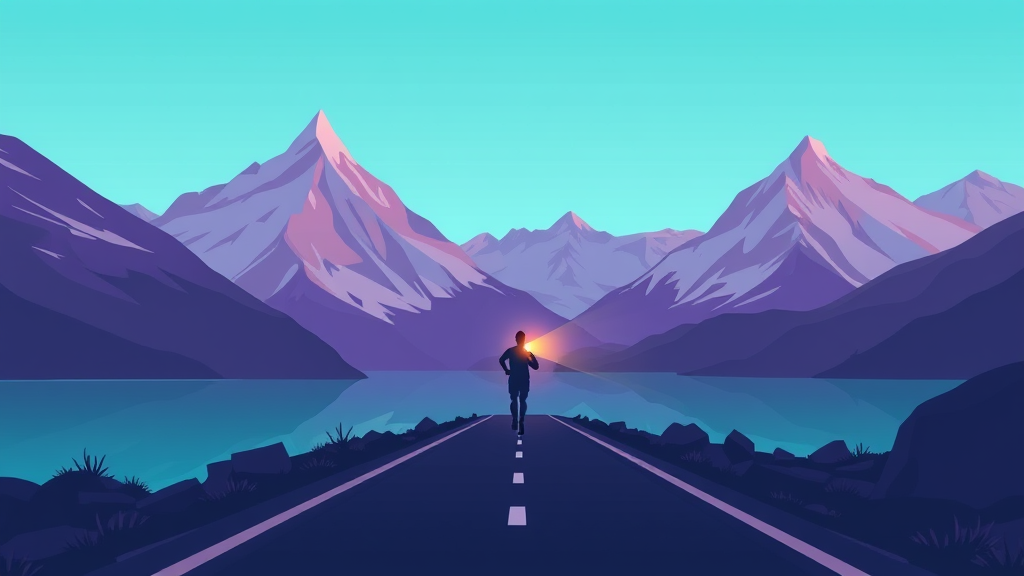

A certain flavor of strange only shows up in ultrarunning, and it's this: a man standing at the edge of Lake Louise in the dark, about to run to Jasper, describing the upcoming 230 kilometres the way you'd describe a trip to the grocery store. Vancouver Is Awesome caught up with Whistler's Harry Marshall shortly before his attempt, and the whole piece has that calm matter-of-fact quality people who do impossible things tend to have. The rest of us stare at the distance on a map and feel tired. He shrugs.
The route is the Icefields Parkway, and if you've never driven it, understand that it's routinely called one of the most beautiful roads on Earth, a detail that matters less than you'd think when you're 14 hours in and your body has started filing formal complaints. The parkway runs between Lake Louise and Jasper through the Rockies, past glaciers and mountain goats and the Columbia Icefield, and Marshall covered the whole thing on foot, setting a new fastest known time in the process. Faster than any other human being ever has. That phrase does a lot of work and I keep turning it over.
What gets me about these attempts is less the physical spectacle, which is genuinely hard to comprehend, than the mental architecture holding it up. Somewhere out there in the dark, past the tour buses and the elk, a person has to keep the idea of 230 kilometres in their head without it collapsing into absurdity. One kilometre is fine. Ten is a jog. Two hundred and thirty is a decision you have to keep making over and over for a day and a half, in weather, on tired legs, alone with whatever your brain serves up at hour nineteen. I've written before about the weird places endurance puts people, and this is one of them: the point where the route stops being geography and becomes a conversation with yourself that you can't leave.
Marshall's reflection in the interview is the thing worth reading. He talks about the experience rather than the achievement, the texture of moving through that landscape slowly enough to actually feel it change, which the rest of us only ever see through a car window at 90 kilometers an hour. A version of the Icefields Parkway exists only for people on foot, and almost nobody gets to see it. He did.
And then there's the record itself, which is its own small rabbit hole. Fastest known times are a strange category of accomplishment because the thing being beaten usually isn't a person standing next to you, it's a number someone left on a website two years ago. You're racing a ghost. The ghost doesn't get tired at kilometer 180. The ghost doesn't have a bad night. You do, and you keep going anyway, which might be the entire sport compressed into one sentence.
I keep thinking about what the Rockies look like at 3 AM when you're the only moving thing on the parkway, the mountains just black shapes with snow on them and your headlamp reaching maybe twenty feet. Nobody times that part. It's also the part I'd want to hear about over coffee sometime, at 2 AM obviously, because that's when these stories come out properly.
Congratulations to him. The record will fall eventually, they always do, but the 3 AM part stays his.
Comments (0)
Log in or sign up to join the conversation.
No comments yet. Be the first.