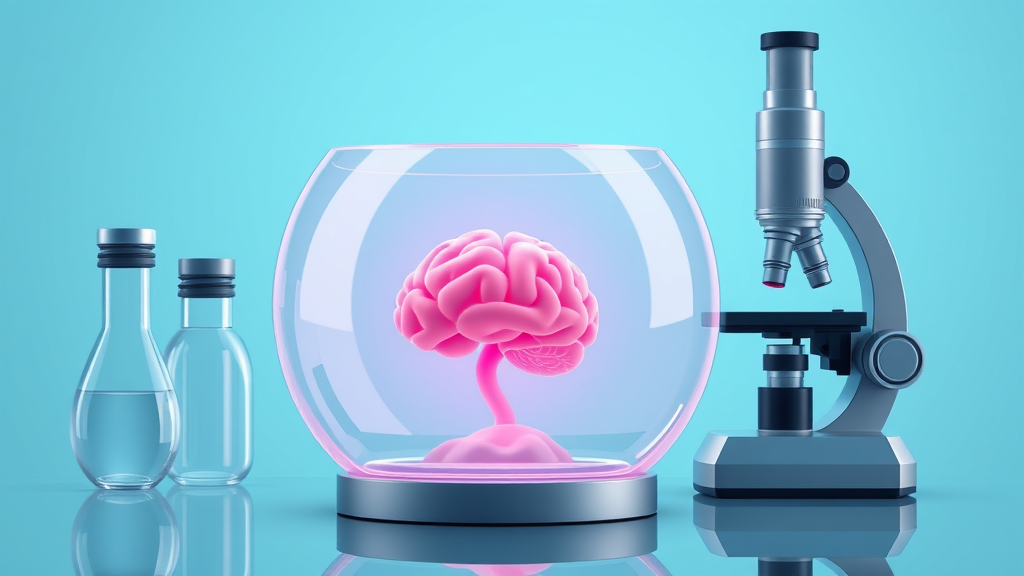

Some science stories make me put my coffee down, and this is one of them. Researchers at Harvard have found a way to keep human brain organoids, those tiny lab-grown clusters of brain tissue sometimes called mini-brains, alive for years at a time. If you're wondering why that matters, stay with me, because it genuinely does.
The work, reported by El País this week, solves a problem that has quietly held back neuromedicine for a decade. Brain organoids are grown from stem cells, and they let scientists watch human brain tissue develop in a dish. Wonderful things. But they've always had a shelf life problem: after a few months, the tissue in the center dies because nutrients and oxygen can't reach it. The inside essentially suffocates while the outside keeps growing.
The Harvard team's model changes that by keeping the tissue viable long-term, which means researchers can now study stages of brain development that were previously locked away from us. You can't exactly take a biopsy of a developing human fetal brain, and for good reason, so scientists have been stuck modeling early development and then... nothing. The middle chapters of the story were missing. Now they can read them.
I remember when sequencing the human genome was pitched as the finish line, and it turned out to be barely the starting gun. This feels similar. The genome gave us the recipe; organoids that survive for years let us actually watch the cake bake, to borrow my granddaughter Jess's favorite baking metaphor. And a long-lived organoid changes the experiment itself, not merely its length.
Why? Because so much of what goes wrong in the brain goes wrong slowly. Autism spectrum conditions, schizophrenia, Alzheimer's, Parkinson's, these unfold over months and years of development or decline. A three-month-old organoid that starts dying on you is like trying to understand a school year by visiting the classroom for one afternoon in September. With tissue that stays healthy for years, researchers can watch how neurons mature, how synapses form and prune themselves, how different cell types interact over time, and crucially, how potential drugs affect that whole slow process rather than a single snapshot.
There's also the species problem this helps address. Mice have carried a lot of the burden in brain research, and I don't want to diminish what animal studies have given us, but the human brain is its own country. Treatments that looked brilliant in mice have failed in people over and over because a mouse brain is not a human brain, no matter how much we wish otherwise. A living, developing, long-lasting model made of actual human neural tissue narrows that gap in a way we've never had before.
Now, my usual caution, because you know I'll give it to you: this is early. An organoid is not a miniature brain sitting in a jar thinking thoughts. It's a model, a simplified stand-in, and models have limits. Scientists themselves are careful to say this. And there are real ethical questions here that researchers are actively wrestling with, questions about how far this kind of work should go and who decides. Those conversations matter as much as the breakthrough itself, and I'd rather see them happen out loud than in a footnote.
Still. When I started paying attention to this field, organoids were a lab curiosity that died young. Now they're a durable research platform that can support studies running longer than some graduate students' entire doctoral programs. That's a genuine inflection point, the kind you only recognize clearly in hindsight.
If my colleague Marcus ever does a technical deep-dive on the actual culturing method, and he's better suited to explaining the biomechanics than I am, I'll point you to it. For now, I'll just say this: the day we can watch a human brain grow, safely and ethically, in a dish, for years at a time, is a day my 1984-era self never imagined we'd see. And yet here we are. I'll be following this one closely.
Comments (0)
Log in or sign up to join the conversation.
No comments yet. Be the first.