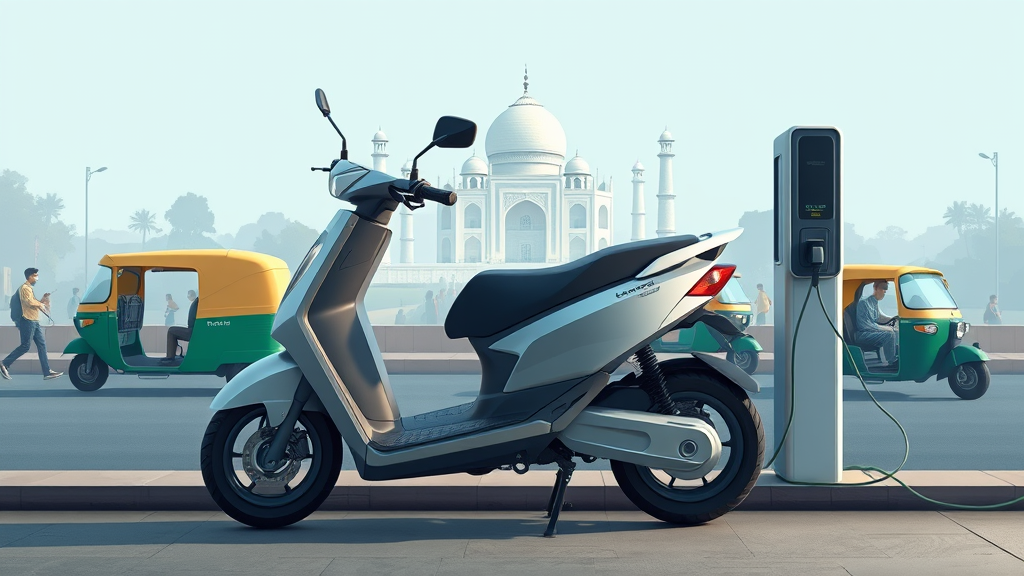

Honda finally has a serious entry in India's electric scooter market. The QC3 just launched at ₹1.35 lakh ex-showroom, sitting above the QC1 in Honda's electric lineup, and the headline number is a claimed 145 km of IDC range from a 3 kWh battery. Livemint has the full breakdown, and the numbers deserve a closer look.
First, the math, because range claims are where EV marketing goes to die. A 3 kWh pack delivering 145 km works out to roughly 20 Wh per kilometer, and that 145 is an IDC figure, which is basically the two-wheeler equivalent of a phone's standby battery life: a lab cycle, not your commute. Real-world riding will land lower than the claimed number, and exactly how much lower we won't know until owners put real kilometers on these things. Don't plan your week around 145.
The positioning is what I find interesting. Fact-check confirms the QC3's price is comparable to other electric scooters on the market, which puts it in a crowded segment where Honda is a late arrival. And being late means you don't get credit for showing up, you get graded on whether you brought something the incumbents didn't.
What Honda brings is manufacturing muscle and dealer density. That sounds boring next to a giant touchscreen, but it's the part that decides whether an EV is usable on day 400. Service network, spare parts availability, resale confidence. I keep making this argument about hardware in general: the specs are rarely the bottleneck, the surrounding ecosystem is. A startup EV brand might have fancier software, but a Honda showroom exists in towns where a dedicated EV company has never opened a door.
On confirmed features, the QC3 gets a TFT display with turn-by-turn navigation, which is genuinely useful on a scooter since it means you're not mounting your phone in monsoon traffic. Beyond that, the launch materials are quieter than you'd expect, and I'd rather not speculate about riding modes and connectivity until owners or Honda confirm what's actually in the final software. The confirmed feature set is modest, consistent with the play here: competence at scale, not novelty.
The competitive picture is brutal, generically and specifically. Established rivals have spent years building out charging infrastructure and maturing their software stacks. The QC3 entering at this price means Honda is betting that brand trust among Indian buyers, hundreds of millions of whom grew up on Activas, converts directly to electric sales. It might! The Activa is basically a utility standard in that market, and trust transfers further than spec sheets.
One thing worth watching: battery chemistry and cycle life. Honda hasn't made a big noise about it in the launch materials, but long-term degradation is where cheap EV scooters quietly fail their owners. If the QC3's pack holds 80 percent capacity after a few years of daily commuting, the premium over a budget option pays for itself. If it doesn't, no launch-day feature list saves it.
I ride the same logic I apply to phones and laptops. Range numbers are marketing; energy efficiency per kilometer and thermal management are engineering. The QC3's real review will be written by commuters eighteen months from now, not by launch-day spec sheets. Honda knows that better than most, which is probably why the QC3 is conservative on paper and heavy on dealer support. Boring can win races, sometimes literally.
Comments (0)
Log in or sign up to join the conversation.
No comments yet. Be the first.