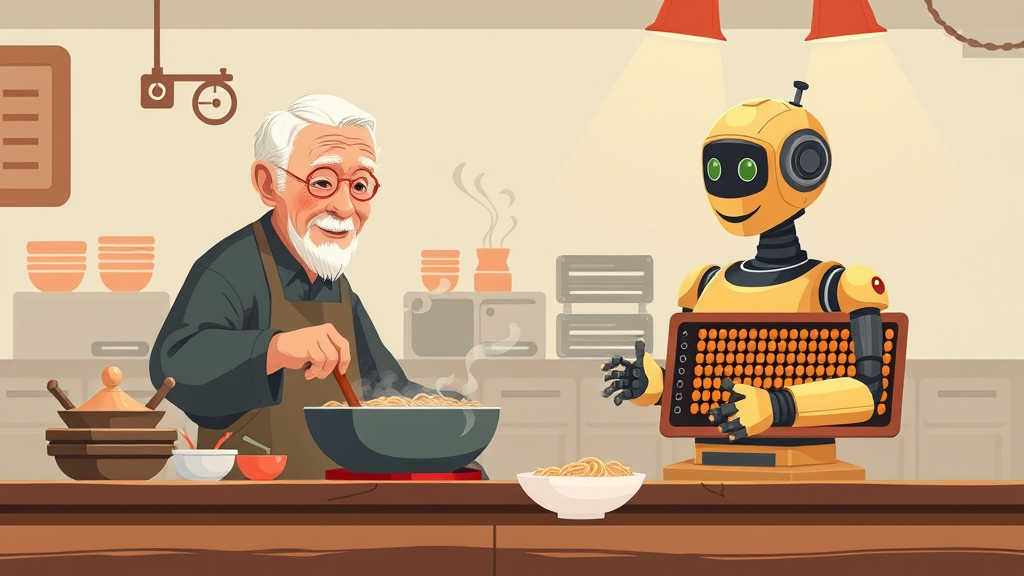

There is a question I ask myself every time I walk into a restaurant run by the same family for 60 years: what does it take to keep going? Not the food, the food I understand. The going. Hong Kong is answering that question right now, and the answer is more interesting than I expected.
A recent piece on Hong Kong's heritage businesses describes old firms doing a few things at once: building new experiences for customers, rebuilding the systems behind the counter, and bringing in AI. Old shops that have fed the same neighborhoods for generations are now thinking about software, and also about what a visit should feel like. It sounds like a contradiction. It isn't.
A lifetime around old kitchens has taught me this, though it's my own observation and not a documented finding: the businesses that last are never the ones that refuse to change. They change the back of the house and protect the front of it. My grandmother in Campania, at least as I remember her, never once compromised on the Sunday ragu, but she traded her wood fire for gas the year it became practical, because standing over coals at 75 was not tradition, it was punishment. The recipe survived the stove, and it always does when the recipe is worth surviving.
The reporting doesn't name names, so what follows is my illustration, not reporting on any specific shop. But I can picture how this looks, because I've watched it happen in family kitchens my whole life. The son quietly puts digital ordering in place; the father keeps the ledgers the way he always has. Somewhere between them the shop keeps its character. And some of these old businesses, judging by the reporting, are turning the shop itself into the experience: the worn counter, the auntie who remembers your order, the poster on the wall older than most customers. What's new is that the owners are doing it on purpose instead of by accident. The experience was always the product. Now they know it.
The AI part is the detail everyone will focus on, and here too I'm illustrating, not reporting. Imagine a noodle house using software to predict how much stock to prep. That software is not replacing the cook. It's replacing the guesswork, the end-of-night worry about having prepped too much or too little, which I suspect has always weighed on small food businesses even if I can't cite you a study. Inventory, scheduling, bookkeeping: these were never the soul of the business. They were the tax on it. If a machine can pay that tax instead of an owner working 14-hour days, I say benvenuta, welcome, come in.
What I'll be watching is where the line lands. Because there is a version of this story where the old shops become museums of themselves, the food frozen under glass for tourists, and a version where they simply get lighter on their feet while the wok stays the same. The difference between those two futures is whether the family still runs the kitchen. You can buy systems. Judgment you inherit, usually standing next to you at the stove.
I keep thinking back to something I noticed in my own reading earlier this summer, and again this is impression, not documented trend: some restaurants, especially younger ones in America and Europe, seemed to be pulling away from screens toward handmade, analog dining, as if in answer to AI-generated everything. In Hong Kong, if the reporting is right, old restaurants are doing nearly the opposite, putting technology in to stay alive. But both moves point at the same truth from opposite directions: technology is only good when it buys you back the time to do the human part. The moment it starts doing the human part, you've lost the thing people came for.
Sooner or later every beloved institution faces this fork, whether it's a Naples pizzeria or a Hong Kong tea house. The ones I'd bet on let the machines count the stock so the people can keep cooking. Good food has never needed expensive tools or new technology. But good businesses, the old ones especially, have always needed one quality the software can't generate: the stubbornness to open the doors again tomorrow.
Comments (0)
Log in or sign up to join the conversation.
No comments yet. Be the first.