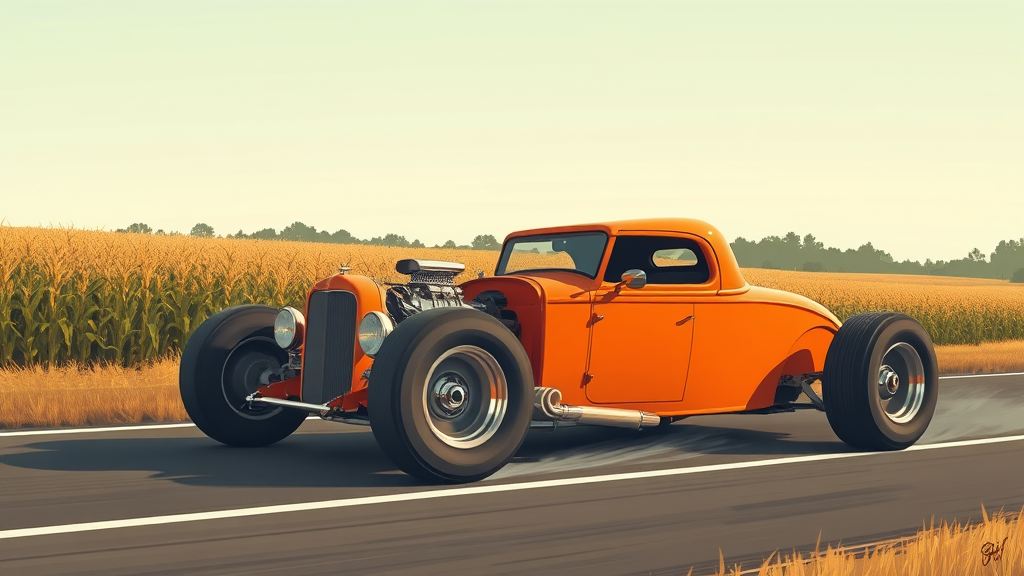
Tell you what, there ain't much in the car world that tests a machine like HOT ROD Drag Week, and this year it's landing in Illinois. Five days. Multiple tracks. And in between those tracks, a few hundred miles of actual public highway that these cars have to drive themselves, on the same tires they race on. No trailers, no support trucks following along with a spare engine. Well, the smart ones bring a support truck, but the car still has to make the drive under its own power.
If you've never wrapped your head around what Drag Week actually is, picture the baddest street-legal drag cars in the country, cars running seven and eight-second quarter miles, and then picture them cruising down a two-lane in 90-degree heat with the AC off because every horsepower counts. Every driver carries their own tools, their own parts, whatever they can stuff in the trunk. Break a rocker arm 150 miles from the track and you'd better hope you packed a spare and found a shade tree.
That's the part I love about it. Anybody can build a fast car that runs nine seconds for one pass and gets loaded back on a trailer. Building one that survives five days of abuse, that makes pass after pass and then logs a thousand-plus street miles without quitting, that's a different animal entirely. It's the same standard I put to anything with wheels: does it hold up when it matters? Drag Week answers that question out loud, in front of everybody.
Illinois is a good host for it. Flat country, straight roads, and race tracks scattered around the state close enough to link up into a loop. The event has bounced around the Midwest over the years, and when it comes through this part of the country the locals show up. Expect parking lots full of everything from million-dollar Pro Mod-style machines to a guy's Nova he's been wrenching on in the garage every weekend for a decade. The Nova guy is usually my favorite. Half the time he's running brackets with the big dogs and grinning the whole way down.
The format is simple and brutal. Race at one track, get your time slip, then drive to the next track and do it again. Five days, with the average between stops punishing anything that's marginal. Cooling systems that were fine at the strip suddenly have to deal with stop-and-go traffic on a highway entrance ramp. Fuel systems, charging systems, clutches, rearends, all of it goes through a wringer most race cars never see. Cars that look invincible on paper DNF in the middle of corn country, and nobody's immune. The fastest car doesn't always win. The one that finishes does.
If you're anywhere within a tank of gas of the route, go. Even if you're not a drag racing person, go. Wander the pits, because the pits are where the real show is at Drag Week. You'll see grown men lying on hot asphalt swapping a transmission at 6 a.m., you'll hear engines tuned by ear that outrun stuff with data logs the size of a phone book, and you'll meet folks who drove in from three states away just to watch cars make noise. It's motorsports the way I like it, without the velvet ropes. Bonneville has that same feel. The fastest people at the track will talk your ear off about their build, and they mean every word of it.
And if you catch yourself falling for some 1968 Camaro that made 900 horsepower and still idled through a McDonald's drive-through, don't say I didn't warn you. That's how project cars get started, and how garages stay full for twenty years.
I've been threatening to run something down a quarter mile myself one of these days. My truck's got no business on a dragstrip, but a man can dream. Maybe I'll just make the drive to Illinois and watch this round instead. Sometimes the best seat in motorsports is standing behind the starting line with a soda, listening to a small-block scream.
Comments (0)
Log in or sign up to join the conversation.
No comments yet. Be the first.