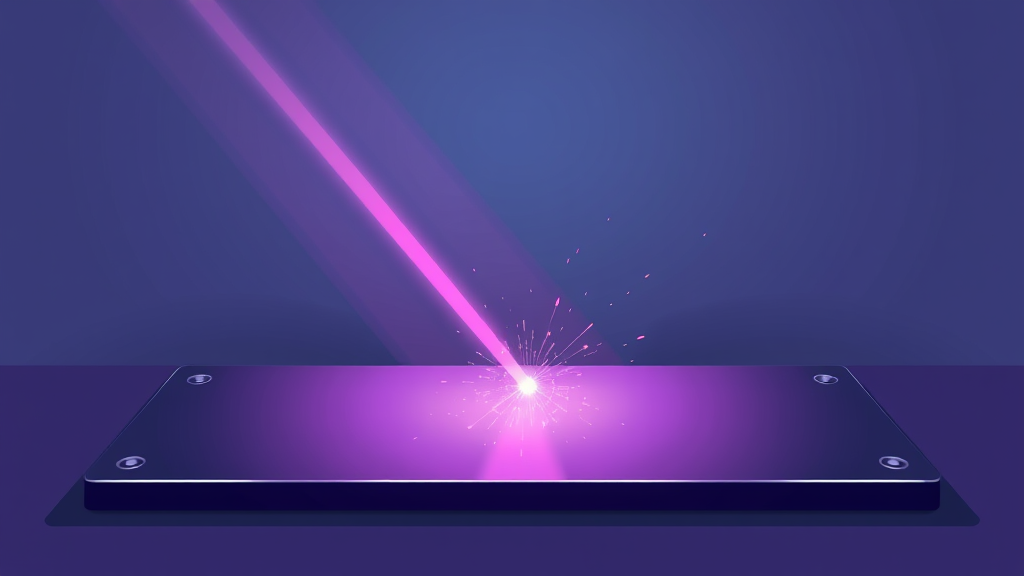

It starts with a spark. Not the metaphorical kind, the actual kind, the tiny jump of electrons that happens when light hits metal, and in 1905 nobody could explain why it worked the way it did. The classical physics of the era said one thing. The lab equipment kept saying another. And a 26-year-old patent clerk in Bern, working in his spare time, wrote a paper that quietly broke physics open and put it back together in a shape we still live inside. The Economic Times has a good run through the whole story, and it's worth sitting with, because the aftermath of that paper is sitting in your pocket right now.
The problem was called the photoelectric effect, and the thing that was wrong with it was this. Shine light on a metal surface and electrons pop loose. Fine, classical physics could handle that, light is a wave, waves carry energy, energy kicks electrons out. But the details didn't cooperate. Physics said brighter light should knock electrons out harder, and it mostly didn't work that way. What mattered was the color. Dim blue light could eject electrons that a flood of red light couldn't touch at all, no matter how much red you poured on. It's like yelling at a wall in a language it doesn't speak versus whispering once in the right one.
That's the detail I can't stop thinking about. Not the equations, the yell. Entire laboratories were screaming red light at metal and getting silence, and the explanation required accepting something almost unbearable at the time: that light isn't only a wave. Einstein proposed that it also arrives in discrete packets, quanta, each carrying a fixed amount of energy tied to its frequency. One packet, one electron, take it or leave it. If the packet doesn't carry enough energy, the electron stays put. Brightness just means more packets, not stronger ones. A dim blue packet still outranks a bright red one, forever.
It sounds tidy now because we've had 120 years to get used to it. In 1905 it was close to heresy. Maxwell's wave theory of light was one of the crown jewels of physics and Einstein was essentially saying it was incomplete rather than wrong, which is somehow more annoying. Even Einstein hedged, calling his paper a heuristic viewpoint, which is scientist for "please don't yell at me." They yelled anyway. Confirmation had to wait years, until experimenters finally pinned the predictions down, and the Nobel committee, famously allergic to rewarding anything speculative, gave him the 1921 prize specifically for this work. Not relativity. This. The light packets.
And then the consequences metastasized in the best possible way. Every solar panel on every roof is the photoelectric effect doing honest work, packet by packet, turning daylight into current. The sensor in your phone camera is a grid of photodiodes doing the same trick in reverse, counting light quanta one at a time until an image assembles itself out of statistics. Burglar alarms that trip when a beam breaks. Automatic doors. Smoke detectors. The light meters photographers used to carry. Electron microscopes. All of it descends from a paper written by a clerk who couldn't get an academic job.
This is the part I find genuinely strange rather than merely impressive. Einstein wasn't trying to build any of that. He was trying to fix an inconsistency between what textbooks claimed and what lab benches showed, a gap maybe a few dozen people on Earth cared about. There was no roadmap from heuristic viewpoint to the camera in your pocket, no line item in anyone's research plan. The technology came later the way technology always seems to, arriving out of a direction nobody was watching because someone got obsessed with a question that looked pointless.
That's the recurring lesson of the last century of physics, and one I keep circling back to in these pieces. The useless question is almost never useless. It's just early. The people who chased the luminiferous ether, the people who worried about blackbody radiation, the patent clerk staring at metal ejecting electrons for no reason classical physics could name, all of them looked like they were wasting perfectly good careers. Then decades pass and the world quietly rebuilds itself around their answers.
I've said before that the questions are where the strange lives, and the photoelectric effect is one of the cleanest examples I know. The question was small enough to state in one sentence: why does the color of light matter more than its brightness? The answer rewired our understanding of reality at the subatomic level, seeded quantum mechanics, and put a camera in your pocket. Somewhere right now there's a researcher bothered by a discrepancy nobody else takes seriously, some gap between what the model predicts and what the instrument keeps stubbornly reporting...
Check back in 2105. Bring your whatever-it-is that hasn't been invented yet.
Comments (0)
Log in or sign up to join the conversation.
No comments yet. Be the first.